
Every property manager faces the same question when evaluating smart access control systems: “When will this investment actually pay for itself?” Unlike cosmetic upgrades that simply enhance aesthetics, modern access control technology delivers measurable returns through reduced operational costs, decreased security incidents, and improved property value. Understanding the financial timeline helps decision-makers justify the transition from traditional key-based systems or outdated card readers to cloud-based platforms that integrate with broader security ecosystems.
The answer depends on your property type, current security infrastructure, and specific operational challenges. A 300-unit luxury high-rise in Brickell will see different ROI factors than a Class A office building in West Palm Beach or a mixed-use development in Fort Lauderdale. This analysis breaks down the tangible costs you’re avoiding and the revenue you’re protecting to determine exactly when upgrading makes financial sense.
The Hidden Costs of Traditional Access Control
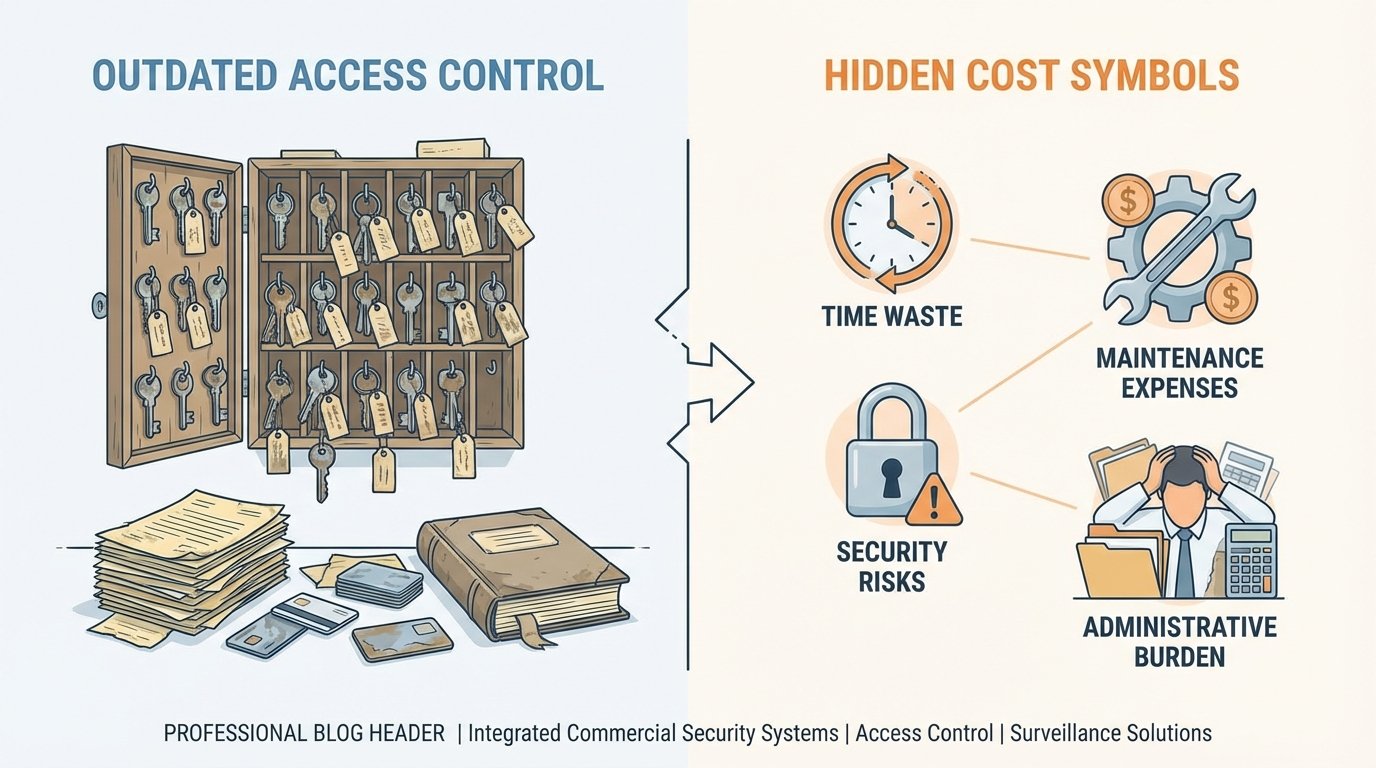
Before calculating returns on new technology, you need to understand what your current system actually costs. Traditional lock-and-key systems or first-generation card readers carry expenses that rarely appear on balance sheets but significantly impact your bottom line.
Physical Key Management Expenses
Properties still using physical keys face constant rekeying costs. When a tenant moves out, an employee leaves, or a key goes missing, you’re paying a locksmith $100-300 per door to rekey cylinders. A 200-unit apartment community averaging 25% annual turnover rekeys 50 units yearly at roughly $150 per unit—that’s $7,500 annually just maintaining basic security. Office buildings face similar challenges when employees separate or lose credentials.
Master key systems compound this problem. A single lost master key can require rekeying dozens or hundreds of doors simultaneously, creating emergency expenses of $5,000-15,000 depending on property size. These situations occur more frequently than property managers expect, particularly in multi-tenant environments with high traffic.
Labor Costs for Access Management
Staff time represents another hidden expense. Property managers and front desk personnel spend hours weekly managing physical access—signing out keys, tracking who has access to which areas, coordinating with vendors who need temporary building access, and updating access permissions when leases end or employee roles change.
For a managed office building, estimate 5-10 hours weekly on access-related administration at $25-40 per hour. That’s $6,500-20,800 annually in labor that could be redirected to revenue-generating activities or tenant services. Hotels face even higher costs coordinating contractor access to mechanical rooms, pools, and back-of-house areas while maintaining security protocols.
Security Incident Costs
The most significant hidden cost is security breaches. Unauthorized access events—whether from copied keys, unreturned credentials, or tailgating through entrances—lead to theft, vandalism, and liability exposure. A single significant theft incident can cost $10,000-50,000 in stolen property, not including insurance deductible increases or potential liability if someone is injured during a break-in.
Properties without integrated security systems also face higher insurance premiums. Many commercial insurance providers offer 10-20% premium reductions for properties with professionally monitored, integrated security ecosystems that combine access control with surveillance cameras and alarm systems.
Calculating Your Current System Costs
Use these categories to establish your baseline annual expenses:
- Rekeying and locksmith services: Track all lock changes, emergency lockouts, and master key system updates over the past 12 months
- Physical credential costs: Calculate money spent on keys, fobs, cards, and replacement credentials
- Administrative labor: Estimate hours spent managing access, multiplied by loaded hourly rates including benefits
- Security incidents: Add documented costs from theft, vandalism, or unauthorized access events
- Insurance premiums: Note current commercial property insurance costs for comparison after system upgrade
- Emergency response: Include after-hours calls to address lockouts or access issues requiring immediate attention
A 250-unit multi-family property typically discovers $15,000-30,000 in annual costs across these categories. Commercial office buildings with 100+ tenants often exceed $25,000-40,000 annually. These figures establish your baseline—the costs you’ll eliminate or drastically reduce with smart access control systems.
Investment Requirements for Modern Systems
Smart access control systems require upfront capital investment, but understanding the complete cost structure prevents surprises and allows accurate ROI calculations.
Hardware and Software Components
Cloud-based access control from providers like Brivo or Verkada typically costs $800-1,500 per door including controller hardware, electronic locks or strikes, and power supplies. A 200-unit apartment community securing common entrances, amenity areas, and parking facilities might install 15-25 controlled access points, totaling $12,000-37,500 in hardware.
Cloud platforms charge monthly subscription fees of $10-30 per door for software access, hosting, and automatic updates. For our example property, that’s $150-750 monthly or $1,800-9,000 annually. These fees replace the costs of maintaining on-premise servers, managing software updates, and hiring IT support for traditional systems.
Integration with existing security infrastructure adds value without doubling costs. When access control systems communicate with surveillance cameras from manufacturers like Axis Communications or Hanwha Vision, you create automated event recording—cameras automatically capture video when doors open after hours or when access is denied. This integration typically adds 10-20% to project costs but dramatically improves security effectiveness.
Professional Installation Investment
Licensed electrical contractors handle installation from low-voltage cabling and network infrastructure to final system configuration. Professional installation costs $200-600 per door depending on building construction, distance from network infrastructure, and power requirements.
This investment ensures code compliance, proper integration with fire alarm systems where required, and warranty protection that DIY installations forfeit. Properties in South Florida must also consider hurricane-resistant installation methods and backup power systems that unlicensed installers often overlook.
Mobile Credentials and User Experience
Modern systems use smartphone-based credentials instead of physical cards or fobs. Residents, tenants, and employees download an app and receive digital keys that can be activated instantly and revoked remotely. This eliminates physical credential costs ($5-15 per card or fob) and replacement expenses when credentials are lost.
Mobile access also enables features impossible with traditional systems—temporary credentials for guests that automatically expire, delivery access with time restrictions, and detailed audit trails showing exactly who accessed which areas and when.
Quantifying Returns and Payback Timeline
ROI calculations compare your current annual costs against the investment required for upgraded systems, then project how quickly eliminated expenses offset the upgrade investment.
Immediate Cost Eliminations
Smart access control systems immediately eliminate several expense categories:
- Zero rekeying costs: Digital credentials are instantly issued and revoked without touching physical locks
- Reduced administrative labor: Automated access management cuts staff time by 60-80%
- No physical credential replacement: Lost smartphones don’t compromise security since credentials are remotely deactivated
- Eliminated emergency lockout calls: Property managers grant temporary access remotely without dispatching staff
For our 200-unit example property currently spending $25,000 annually on traditional access management, these eliminations create $15,000-20,000 in first-year savings.
Revenue Protection and Enhancement
Beyond cost reduction, commercial access control improves revenue in measurable ways:
Reduced vacancy from improved security: Properties with comprehensive security systems—access control integrated with surveillance cameras and professional monitoring—achieve 5-10% higher occupancy rates and command premium rents. For a 200-unit property averaging $2,000 monthly rent, reducing vacancy by just 2% generates $48,000 additional annual revenue.
Lower insurance premiums: Documented security improvements often qualify for 10-20% commercial insurance reductions. A property paying $40,000 annually might save $4,000-8,000 yearly with professionally installed, monitored systems.
Decreased liability exposure: Detailed access logs and integrated video surveillance protect property owners from false liability claims and provide evidence for legitimate security incidents. While difficult to quantify until you need it, this protection has prevented six-figure lawsuit settlements for properties with comprehensive audit trails.
Amenity monetization: Properties can charge premium fees for enhanced security features, smart building technology, and convenient mobile access that residents increasingly expect. Many luxury multi-family properties now include technology packages as separate line items generating $25-50 monthly per unit.
Sample ROI Calculation: 200-Unit Multi-Family Property
Let’s calculate payback timeline for a specific scenario:
Current annual costs (traditional system):
- Rekeying and locksmith services: $7,500
- Physical credentials and replacements: $3,000
- Administrative labor: $12,000
- Security incidents (average): $8,000
- Total annual cost: $30,500
Upgrade investment (cloud-based access control):
- Hardware for 20 access points: $20,000
- Professional installation: $8,000
- Integration with existing cameras: $3,000
- Total upfront investment: $31,000
- Annual software fees: $4,800
Annual savings and revenue gains:
- Eliminated traditional costs: $30,500
- New software fees: -$4,800
- Net operational savings: $25,700
- Insurance premium reduction (15%): $6,000
- Reduced vacancy impact (1.5%): $36,000
- Total annual benefit: $67,700
Payback period: 5.5 months
This property recoups its entire investment in under six months, then continues realizing $67,700 in annual benefits. Over five years, the net return exceeds $307,000 against a $31,000 initial investment—an exceptional return that few property improvements can match.
Factors That Accelerate or Extend Payback
Property Characteristics That Improve ROI
Certain property types see faster returns on access control investments:
High-turnover properties: Multi-family residential communities, hotels, and co-working spaces with frequent access changes eliminate the most manual labor and rekeying costs. Student housing properties with complete annual turnover see payback in 3-6 months.
Multi-building campuses: Properties where security staff currently drives between buildings to grant access or manage credentials save enormous labor costs with centralized cloud management. Corporate campuses, hospital systems, and large HOA communities fall into this category.
Premium properties: High-end commercial and residential properties command rents where even small occupancy improvements generate significant revenue. A luxury building charging $5,000 monthly rent per unit sees much faster returns than properties at $1,200 monthly.
Properties with compliance requirements: Healthcare facilities, financial institutions, and properties storing sensitive materials face regulatory requirements for access audit trails and credential management. These properties avoid compliance penalties and simplify audits with modern systems.
Situations That Extend Payback Timeline
Some scenarios create longer return periods, though the investment still makes strategic sense:
Small buildings with simple access needs: A 20-unit building with one entrance and stable, long-term tenants won’t eliminate as many costs as larger properties with complex access requirements.
Recently upgraded traditional systems: Properties that invested in proximity card systems within the past 3-5 years have lower current costs and less urgency to upgrade, extending payback to 2-4 years.
Properties requiring extensive infrastructure work: Older buildings needing significant electrical or network infrastructure upgrades face higher installation costs that extend payback timelines, though long-term benefits remain substantial.
Beyond Financial ROI: Strategic Benefits
Pure financial calculations miss strategic advantages that serious property investors value:
Property value enhancement: Buildings with integrated security ecosystems sell at premium valuations. Commercial real estate appraisers increasingly factor smart building technology into property assessments, recognizing that modern infrastructure attracts quality tenants and reduces operational friction.
Competitive market positioning: In competitive markets like South Florida’s luxury residential sector or Manhattan’s office market, comprehensive security technology has shifted from differentiator to baseline expectation. Properties without integrated systems lose tenant prospects to competitors offering smart building amenities.
Scalability for future growth: Cloud-based platforms grow seamlessly as properties expand or portfolios add buildings. Adding new access points requires only hardware installation—no server upgrades or software reinstallation. Multi-property owners manage entire portfolios from unified platforms.
Integration with future technologies: Modern access control systems integrate with visitor management, parking access, elevator controls, and building automation systems. This foundation enables future technology additions without replacing core infrastructure.
Making the Investment Decision
ROI calculations provide financial justification, but the decision also requires evaluating installation partners. The technology only delivers promised returns when professionally designed, properly installed, and reliably supported.
Look for licensed electrical contractors with specific experience in your property type—multi-family residential, commercial office, hospitality, or other sectors each present unique challenges. Authorized partnerships with leading manufacturers like Verkada, Brivo, and Axis Communications ensure access to latest technology, warranty support, and ongoing product development.
Local expertise matters significantly, particularly in South Florida where hurricane preparedness, coastal corrosion resistance, and extreme heat affect equipment selection and installation methods. Companies with regional experience design systems that perform reliably in your specific environment.
The integration capability separates basic installers from true technology partners. Your access control system should communicate with surveillance cameras, triggering recording when doors open unexpectedly. It should tie into visitor management platforms, automatically granting lobby access to pre-registered guests. It should integrate with parking systems, allowing the same credential to open doors and parking gates. These integrations multiply ROI by eliminating redundant systems and creating comprehensive security intelligence.
When to Upgrade: Timing Your Investment
Several situations indicate optimal upgrade timing:
- Planned renovations: Capital improvement projects provide ideal opportunities to install access control infrastructure while walls are open and contractors are already on site
- Insurance renewal: Time upgrades before policy renewal to capture immediate premium reductions
- Tenant turnover: High vacancy periods allow installation with minimal disruption to occupied spaces
- Security incidents: Recent theft or unauthorized access events create urgency and justify immediate investment
- Lease-up for new construction: New properties should launch with smart systems as baseline amenities
- Portfolio expansion: Adding properties provides leverage to implement unified systems across entire portfolios
Budget cycles also matter. Properties planning capital improvements for fiscal year 2026-2027 should begin evaluation and design processes now to ensure system deployment aligns with budget availability.
Next Steps: Calculating Your Specific ROI
Generic calculations provide frameworks, but your property deserves customized analysis reflecting actual conditions, current costs, and specific security needs. Professional security integrators conduct site assessments evaluating your existing infrastructure, identifying vulnerabilities, and designing solutions scaled appropriately to your property.
A proper assessment examines current access points, evaluates network infrastructure capacity, reviews integration opportunities with existing surveillance cameras or other systems, and projects exact costs for your situation. This analysis produces accurate ROI calculations showing precisely when your investment breaks even and begins generating positive returns.
For properties throughout South Florida—from Palm Beach County’s luxury residential towers to Broward County’s commercial office parks and Miami-Dade’s mixed-use developments—professional security technology partners design systems protecting your significant real estate investments while delivering measurable financial returns.
The question isn’t whether to upgrade to smart access control systems, but when. For most commercial properties and multi-family communities, the answer is clear: payback timelines of 6-18 months mean every month you delay costs money. Properties with high turnover, multiple buildings, or premium market positioning see even faster returns, often recouping investments within a single quarter.
Contact Fortress Global Technology to schedule a comprehensive security assessment and receive a customized ROI analysis for your specific property. Our team of licensed security integrators will evaluate your current systems, identify improvement opportunities, and provide detailed financial projections showing exactly when your investment begins paying dividends. With 20+ years of experience designing integrated security ecosystems for large commercial properties throughout Florida and beyond, we’ll help you make data-driven decisions that protect both your property and your bottom line.