
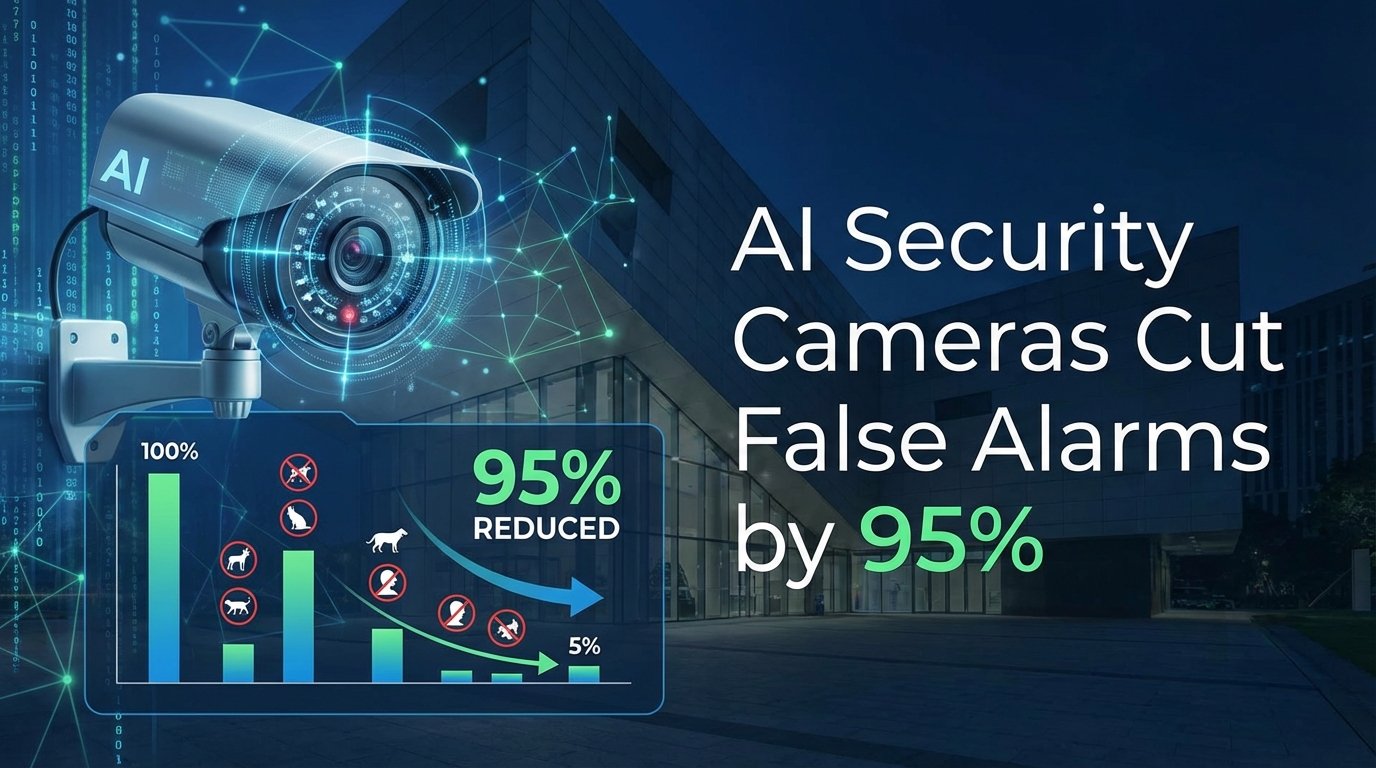
Commercial property security teams waste an average of 98% of their time responding to false alarms. A loose tree branch triggers motion detection. Headlights sweep across a parking lot. A bird flies past the camera. Each generates an alert, and each demands someone’s attention to verify whether it’s a genuine security event or another non-threat.
This isn’t just annoying—it’s expensive and dangerous. Security personnel become desensitized to constant false alerts, increasing the risk that real threats slip through unnoticed. Properties pay for monitoring services that deliver more noise than signal. And facility managers face difficult choices about alarm sensitivity: turn it down and risk missing genuine incidents, or leave it high and drown in false positives.
Artificial intelligence is fundamentally changing this equation. Modern AI-powered security cameras can distinguish between a person walking through a restricted area and shadows moving across the same space. They understand the difference between a delivery truck that belongs at your loading dock and an unauthorized vehicle. This isn’t futuristic technology—it’s available today through commercial security camera installation from experienced integrators like Fortress Global Technology.
The Real Cost of False Alarms in Commercial Security
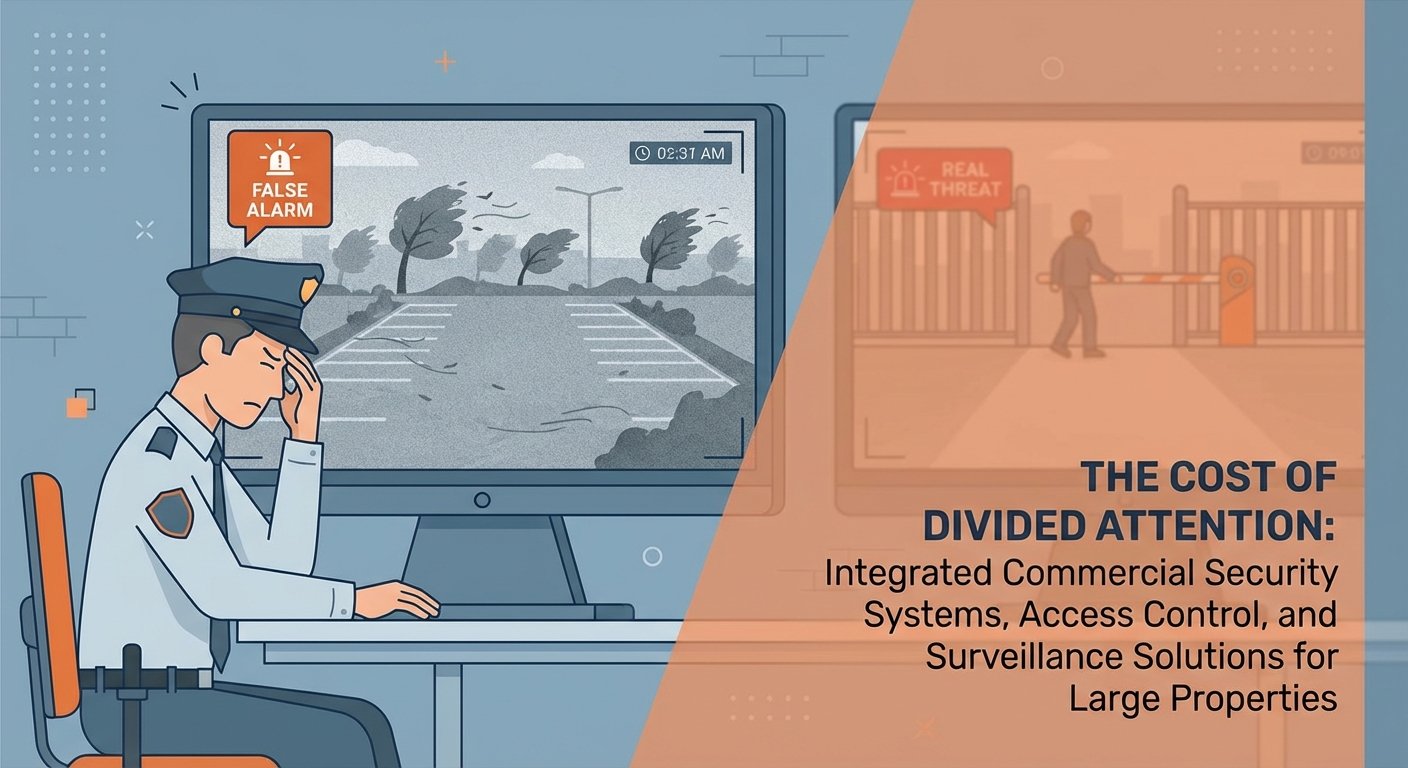
Before exploring how AI analytics solve the false alarm problem, it’s worth understanding exactly what those false alarms cost commercial properties.
Security personnel responding to false alarms divert attention from genuine security concerns. A guard investigating a motion alert in parking area C can’t simultaneously monitor the loading dock or respond to an actual incident elsewhere on the property. This resource misallocation creates vulnerability windows that sophisticated criminals can exploit.
For properties using contracted monitoring services, false alarms directly impact operational costs. Many contracts include response fees for each alarm verification. At $50-150 per response, properties generating dozens of false alarms monthly face substantial unnecessary expenses.
Perhaps more concerning is the psychological impact on security teams. Research in alarm psychology shows that when false alarm rates exceed 90%, human operators develop “alarm fatigue”—a documented phenomenon where personnel become progressively less responsive to alerts. This isn’t negligence; it’s a predictable human response to constant false stimuli. The consequence is that when a genuine security event occurs, the response may be delayed or dismissed entirely.
Insurance implications add another layer of cost. Properties with documented security gaps—including inadequate alarm response—may face higher premiums or coverage limitations. Following an incident, insurance adjusters examine security records. A history showing hundreds of unaddressed alarms doesn’t demonstrate robust security; it reveals a system that management has effectively abandoned.
How Traditional Motion Detection Creates False Alarm Chaos
Understanding why conventional surveillance systems generate so many false alarms requires looking at how traditional motion detection actually works.
Standard IP security cameras commercial properties typically use rely on pixel-based motion detection. The camera compares each frame to the previous frame, and when enough pixels change, it triggers an alert. This approach is computationally simple and works on virtually any camera, which explains its widespread adoption.
The problem is that pixels don’t understand context. Pixel-based detection can’t distinguish between:
- A person entering a restricted area versus tree shadows moving across the same space
- An unauthorized vehicle versus authorized maintenance trucks
- Someone loitering with apparent criminal intent versus an employee taking a phone call outside
- A security threat versus changing light conditions from passing clouds
Weather compounds these challenges significantly. Rain creates countless motion triggers as droplets hit surfaces and run down walls. Wind moves vegetation, signage, and loose materials. Even fog can trigger alerts as it drifts through a camera’s field of view, changing pixel values enough to register as motion.
For Florida properties specifically, intense afternoon thunderstorms and rapidly changing light conditions create particular challenges. A camera overlooking a parking area might generate fifty alerts during a single storm as rain, lightning flashes, and wind-blown debris all trigger the motion detection system.
The traditional response has been to adjust motion sensitivity—creating zones where detection is less sensitive or disabling it entirely in problematic areas. But this approach simply trades false alarms for blind spots, neither of which serves the property’s security needs.
AI Analytics: Teaching Cameras to Understand What They See
Artificial intelligence fundamentally changes how security cameras process visual information. Rather than simply detecting pixel changes, AI-powered analytics teach cameras to recognize and classify objects within their field of view.
Modern AI security cameras use deep learning neural networks trained on millions of labeled images. Through this training, the system learns to identify people, vehicles, animals, and other objects with remarkable accuracy. More importantly, it learns to distinguish these objects from non-threats like moving shadows, weather effects, or changing light conditions.
This capability transforms security monitoring from “something moved” to “a person entered Zone A” or “a vehicle without proper credentials approached the loading dock.” The difference is specificity—and specificity is what eliminates false alarms.
Object Classification and Recognition
At the foundation of AI security analytics is object classification. When movement occurs in the camera’s field of view, the AI system identifies what type of object is moving. Leading platforms like Verkada use computer vision algorithms that can distinguish between:
- People (and often demographic characteristics like clothing color)
- Vehicles (with make, model, and color identification)
- Animals of various sizes
- Bicycles and motorcycles
- Packages and objects
This classification happens in real-time, often within milliseconds of the object appearing in frame. For commercial properties, this means security systems can be configured to alert only when specific object types appear in designated areas.
A loading dock camera might alert when people appear during closed hours but ignore vehicle movement during delivery windows. A perimeter camera could trigger on any human presence while ignoring animals that would have generated constant false alarms in a traditional system.
Behavioral Analysis and Pattern Recognition
Beyond identifying what an object is, advanced AI analytics can evaluate how that object behaves. This behavioral analysis opens powerful capabilities for threat detection while further reducing false alarms.
Loitering detection identifies when someone remains in an area longer than expected patterns suggest. Rather than alerting every time a person appears in view, the system recognizes that someone standing near an entrance for thirty seconds is likely entering the building, while someone standing in the same location for ten minutes represents an anomaly worth investigating.
Direction-based alerts respond only when people or vehicles move in specific directions. A camera monitoring a parking garage exit might alert when someone walks in the wrong direction through the exit lane—a common precursor to theft or unauthorized entry—while ignoring the hundreds of vehicles that legitimately exit each day.
Crowding detection identifies when more people congregate in an area than typically expected, useful for retail properties monitoring for organized retail theft or office buildings tracking occupancy for safety compliance.
Zone-Based Intelligence
AI analytics enable sophisticated zone configuration that would be impractical with traditional motion detection. Security designers can establish multiple zones within a single camera’s field of view, each with different detection rules and sensitivity levels.
Consider a camera overlooking a hotel parking area that also captures a portion of the adjacent public sidewalk. With traditional motion detection, activity on the public sidewalk would generate constant false alarms, forcing operators to either disable detection for that area or tolerate the alerts. With AI analytics, the system can be configured to ignore people and vehicles in the sidewalk zone while alerting on any human presence in the parking area during late-night hours.
This zone-based intelligence extends to integrated security solutions where camera analytics connect with access control systems. A camera covering a secured door can verify that the person who used a credential matches expected characteristics, triggering an alert if the door opens without corresponding card activity or if multiple people enter on a single credential.
Real-World Applications Across Commercial Property Types
The practical impact of AI-powered security camera analytics varies by property type, but the fundamental benefit remains consistent: dramatically fewer false alarms with significantly better threat detection.
Multi-Family Residential Communities
Large apartment complexes and HOA communities face unique security monitoring challenges. With hundreds or thousands of residents, guests, and service providers accessing the property daily, traditional motion detection generates overwhelming alert volumes.
AI analytics enable these properties to implement sophisticated monitoring rules. Cameras covering amenity areas like pools or fitness centers can alert when people appear during closed hours while ignoring activity during operational times. Package rooms—a major security concern for modern multi-family properties—can trigger alerts when someone remains in the area longer than the typical time needed to retrieve a package.
Parking area cameras can identify vehicles moving through the garage at suspicious hours or people walking between cars in patterns consistent with vehicle break-in attempts. Rather than generating alerts for every vehicle entering the garage, the system focuses security attention on genuine anomalies.
Hotels and Hospitality Properties
Hotels present particularly complex security environments with constant legitimate activity that can mask genuine threats. Back-of-house areas, loading docks, and service corridors require security monitoring, but the constant movement of staff, vendors, and deliveries makes traditional motion detection impractical.
AI-powered analytics allow hotel security teams to implement time-based and zone-based rules that align with operational patterns. Loading dock cameras can be configured to alert on vehicle activity outside scheduled delivery windows. Back corridors might trigger alerts when people appear during overnight hours when minimal staff should be present. Kitchen and storage area cameras can identify when multiple people congregate in areas typically occupied by one or two staff members—a pattern that might indicate theft or policy violations.
For guest-facing areas, behavioral analytics identify loitering near elevators or in corridors, helping security teams address concerns before they escalate. The system distinguishes between a guest pausing to check their phone and someone exhibiting suspicious behavior by remaining in an area without apparent purpose.
Office Buildings and Corporate Campuses
Commercial office properties benefit significantly from AI analytics’ ability to adapt to predictable usage patterns. These environments typically have clear “normal” activity profiles: high traffic during business hours, specific individuals accessing the building during early morning or evening hours, and minimal activity overnight.
Modern smart building security systems use AI to learn these patterns and alert when deviations occur. A person appearing in a secured executive floor outside business hours triggers immediate notification. Cameras monitoring high-value areas like server rooms or research facilities can verify that individuals accessing these spaces match expected profiles based on time, day, and access credentials used.
Integration between AI camera analytics and access control systems creates powerful verification capabilities. When an access card grants entry to a secured area, the associated camera can verify that only one person entered (preventing “tailgating”) and can even confirm that the person’s appearance matches expected characteristics based on the credential used.
Retail Centers and Shopping Properties
Retail properties face distinct security challenges including shoplifting, organized retail crime, and after-hours break-ins. AI analytics address these concerns while eliminating the false alarms that plague traditional systems in high-traffic retail environments.
Perimeter cameras can be configured to ignore activity in parking areas and common spaces while alerting when people approach building exteriors outside business hours—a strong indicator of potential break-in attempts. Loading area cameras distinguish between expected delivery vehicle activity and unauthorized vehicles or individuals accessing these typically secured spaces.
For mixed-use developments with retail components, AI analytics enable security teams to establish different rules for different areas based on their operational characteristics, something that would be impossibly complex with traditional motion detection.
Parking Structures and Large Parking Facilities
Parking facilities represent one of the most challenging environments for traditional security cameras. Constant vehicle and pedestrian movement generates overwhelming alert volumes with conventional motion detection, yet these areas require effective monitoring due to frequent vehicle break-ins and personal safety concerns.
AI analytics transform parking facility security by enabling cameras to focus on anomalies rather than routine activity. The system can alert when someone walks between parked cars in patterns inconsistent with retrieving their own vehicle. Cameras can identify vehicles moving unusually slowly through the facility or making multiple passes—behavior often preceding theft or other criminal activity. People loitering in stairwells or elevator lobbies beyond the time typically needed for transit trigger alerts for security investigation.
License plate recognition (LPR) integrated with AI analytics creates sophisticated parking access verification. The system doesn’t just read plates; it can identify when vehicles without proper credentials attempt entry, when plates don’t match expected vehicle characteristics, or when the same unauthorized vehicle makes repeated entry attempts.
Choosing the Right AI Camera Platform for Your Property
Not all AI security camera systems deliver equivalent performance. As with any emerging technology, significant variation exists in accuracy, capabilities, and practical reliability. Properties investing in business CCTV installation should understand the key factors that separate effective AI analytics from marketing claims.
Edge Processing vs. Cloud Processing
AI analytics can run either on the camera itself (edge processing) or on remote servers (cloud processing). Each approach offers distinct advantages.
Edge processing systems like Verkada embed AI processing directly in the camera. This approach provides faster response times since analysis happens immediately without network transmission delays. Edge processing also continues functioning during network outages, maintaining security even if internet connectivity fails. For properties with bandwidth constraints or concerns about cloud dependency, edge processing offers significant advantages.
Cloud-based processing can leverage more powerful computing resources, potentially enabling more sophisticated analysis. However, it requires reliable network connectivity and introduces latency between detection and alerting.
Leading platforms increasingly adopt hybrid approaches, performing primary object detection at the edge while using cloud resources for advanced analysis and pattern recognition across multiple cameras.
Integration Capabilities
AI camera analytics deliver maximum value when integrated with other security systems. The most effective implementations connect camera analytics with access control, visitor management, and intrusion detection to create comprehensive integrated security solutions.
Platforms like Verkada’s Command system unify camera analytics with access control, enabling security teams to correlate door access events with video verification. When a door opens, the system automatically pulls up associated camera footage and can verify that entry matches expected patterns. Axis Communications cameras integrate with virtually any VMS (video management system) through open standards, providing flexibility for properties with existing infrastructure investments.
For properties working with Fortress Global Technology, this integration expertise is particularly valuable. As licensed electrical contractors and authorized integrators for leading platforms, Fortress GT designs security ecosystems where AI camera analytics work seamlessly with access control, intercoms, visitor management, and other security technologies.
Implementation Considerations for Commercial Properties
Deploying AI-powered security cameras requires more than purchasing equipment. Effective implementation demands professional design, proper infrastructure, and ongoing optimization.
Network Infrastructure Requirements
AI-enabled IP cameras typically require more network bandwidth than conventional cameras, particularly models that stream high-resolution video while performing onboard analytics. Properties must ensure adequate network capacity and proper quality-of-service (QoS) configuration to prioritize security traffic.
Professional integrators assess existing network infrastructure and identify necessary upgrades before camera installation. This might include additional network switches, increased internet bandwidth, or dedicated security VLANs to isolate security traffic from other network activity. Fortress Global Technology’s partnership with Velocity MSC enables comprehensive IT and security infrastructure design that ensures all systems have the resources needed for reliable operation.
Camera Placement and Coverage Design
AI analytics don’t compensate for poor camera placement. Cameras must still provide clear views of the areas they’re monitoring, with appropriate resolution to support the analytics being used. Person detection requires sufficient pixel density to distinguish human forms. License plate recognition demands cameras positioned at specific angles and heights relative to vehicle paths.
Professional security design identifies optimal camera locations based on the property’s specific vulnerabilities, traffic patterns, and security objectives. This design process considers lighting conditions at different times of day, potential obstructions, and environmental factors that might affect camera performance.
Training and Rule Configuration
AI analytics require initial configuration and ongoing refinement. Security teams must establish detection rules, sensitivity levels, and alert protocols aligned with the property’s operational patterns and security priorities.
This configuration process typically involves a learning period where rules are adjusted based on real-world performance. A camera might initially generate some false alerts as the system learns to distinguish between routine activity and genuine anomalies. Professional integrators support this optimization process, helping properties refine their systems to achieve the right balance between comprehensive monitoring and manageable alert volumes.
Measuring ROI: Beyond False Alarm Reduction
While dramatically reduced false alarms justify AI camera analytics for most properties, the return on investment extends beyond this single benefit.
Incident investigation time drops significantly when cameras can quickly locate relevant footage. Rather than reviewing hours of video to find a specific event, security teams can search for “red sedan in parking area between 2-4 PM” and immediately access relevant clips. This capability is particularly valuable for large properties where manually reviewing footage from dozens of cameras would be prohibitively time-consuming.
Operational insights emerge from AI analytics that have value beyond security. Retail properties identify peak traffic patterns to optimize staffing. Office buildings track space utilization to inform facility planning. Hotels monitor amenity usage to make informed decisions about resource allocation. The same cameras providing security also deliver business intelligence.
Risk management benefits include better liability protection through more comprehensive and accessible video evidence. When incidents occur, properties can quickly produce relevant footage demonstrating their security measures and response. This documentation proves valuable in insurance claims and legal proceedings.
Labor efficiency improves when security personnel focus on genuine concerns rather than investigating endless false alarms. Some properties reduce contract monitoring costs or reallocate security staff to higher-value activities like customer service and facility management support.
Partner With Security Integration Experts
AI-powered security camera analytics represent a significant advancement in commercial property security, but realizing their potential requires expertise in system design, integration, and ongoing optimization. Properties deserve partners who understand both the technology and the unique operational requirements of large commercial facilities.
Fortress Global Technology brings twenty years of experience designing comprehensive security ecosystems for hotels, multi-family communities, office buildings, and other large commercial properties throughout Florida and nationwide. As authorized integrators for Verkada, Axis Communications, Hanwha Vision, and other leading platforms, Fortress GT designs systems that match technology to specific property needs rather than forcing one-size-fits-all solutions.
Our licensed electrical contractors handle complete installations from infrastructure assessment through final configuration and training. We maintain local support teams throughout our service areas, ensuring that properties receive responsive service throughout their security system’s lifespan.
If your property is struggling with false alarm fatigue or you’re planning security upgrades that should include AI analytics, contact Fortress Global Technology for a comprehensive security assessment. We’ll evaluate your property’s specific vulnerabilities, existing infrastructure, and operational requirements to design an integrated security solution that delivers genuine protection without overwhelming your team with false alerts.
Contact Fortress Global Technology today to discuss how AI-powered security cameras can transform your commercial property’s security operations.