
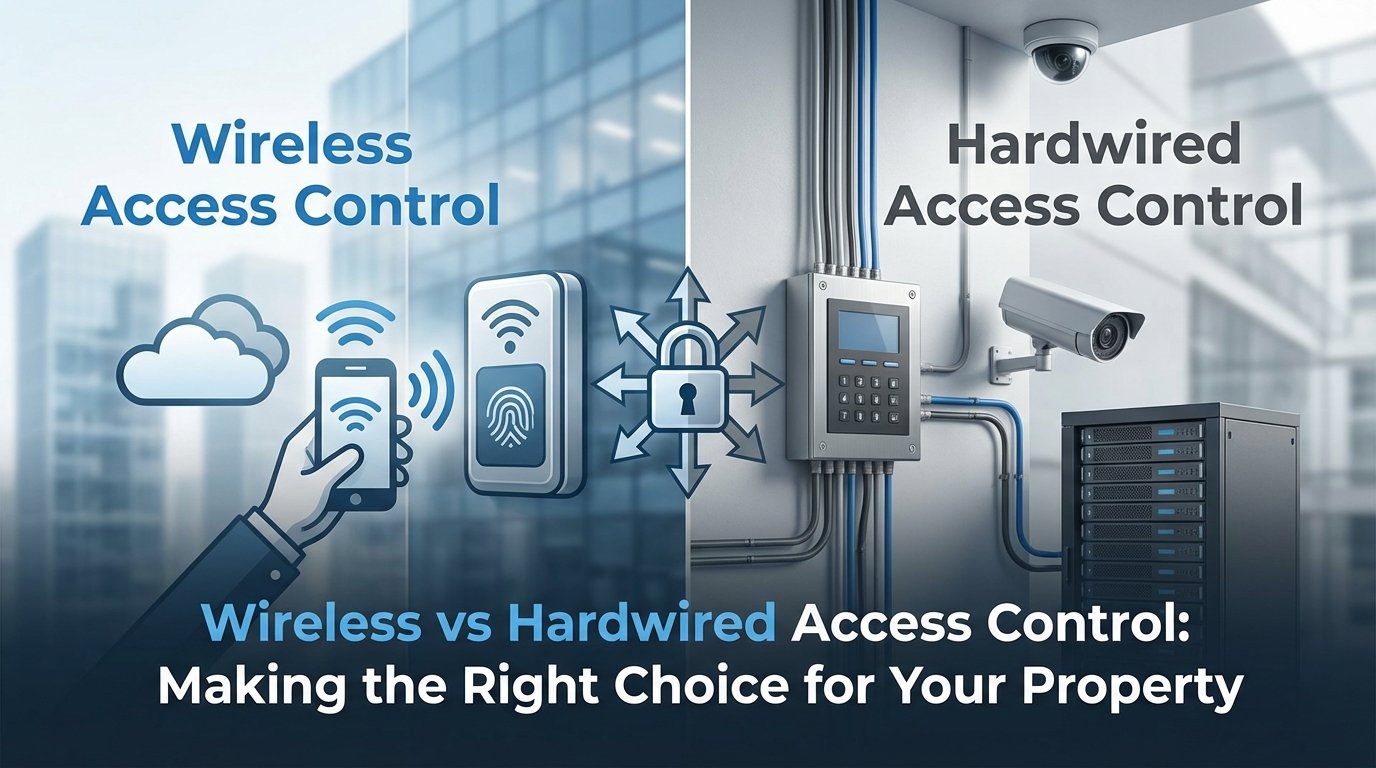
When upgrading security infrastructure for commercial properties, one critical decision often stops facility managers in their tracks: should you invest in wireless access control or stick with traditional hardwired systems? This choice impacts not just your initial installation costs, but also long-term maintenance, system reliability, and scalability for years to come.
For large-scale properties—from 300-room hotels in Boca Raton to 400-unit luxury high-rises in Miami—this decision becomes even more consequential. The wrong choice can mean expensive retrofits, ongoing connectivity issues, or security vulnerabilities that compromise your entire property investment.
Understanding the real-world advantages and limitations of each approach will help you make an informed decision that aligns with your property’s specific needs, existing infrastructure, and operational requirements.
Understanding the Fundamental Differences
Before diving into which solution fits your property, it’s essential to understand how these systems actually work and where the “wireless” designation applies.
Hardwired Access Control Architecture
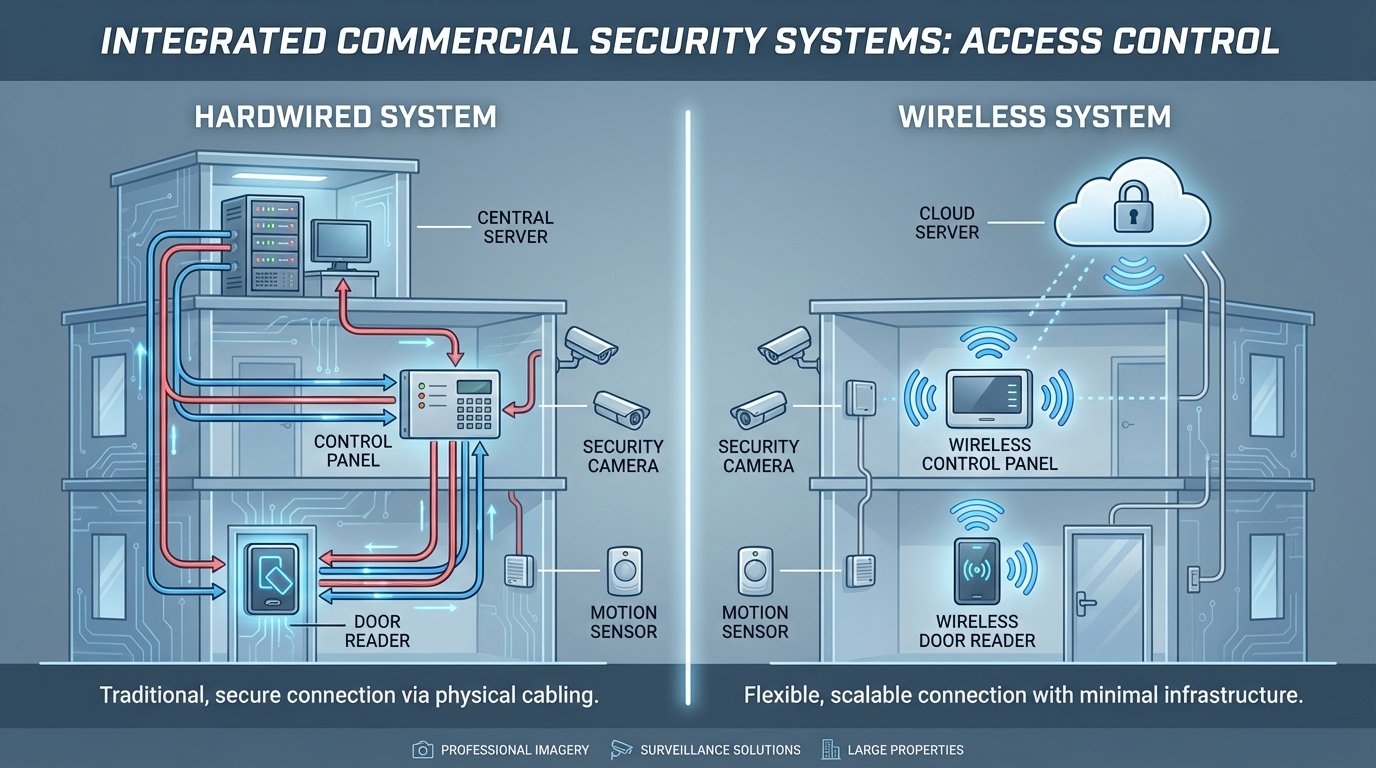
Traditional hardwired access control systems use physical cabling to connect every component. Each door’s card reader, electric lock, door position sensor, and request-to-exit device connects via low-voltage wire back to a central control panel. These panels then communicate with a server that manages credentials, access schedules, and reporting.
For a 500-unit multi-family residential community, this means running dedicated cabling from a central location to potentially hundreds of doors—main entrances, amenity centers, parking garages, package rooms, rooftop access, and mechanical areas. The cabling infrastructure becomes extensive but creates a completely deterministic system where every connection is physical and verifiable.
Wireless Access Control Explained
Wireless access control systems eliminate much of this cabling by using wireless communication protocols (typically Wi-Fi, cellular, or proprietary RF signals) to connect door hardware to the management platform. Modern cloud-based access control systems like Brivo and Verkada leverage existing Wi-Fi networks or built-in cellular connectivity to communicate with their cloud platforms.
However, “wireless” doesn’t mean completely wire-free. Each access point still requires power, and the door hardware (locks, sensors, readers) typically still connects to a door controller via short cable runs. The wireless component refers specifically to how that door controller communicates back to the central management system.
When Hardwired Systems Make the Most Sense
Despite the appeal of wireless technology, hardwired access control remains the gold standard for specific property types and scenarios.
Large-Scale New Construction Projects
When you’re building from the ground up—whether a Class A office tower in downtown Fort Lauderdale or a mixed-use development in West Palm Beach—hardwired infrastructure makes exceptional sense. Construction teams can install conduit and cabling before walls close, eliminating the retrofit challenges that make hardwired systems expensive in existing buildings.
The upfront labor costs blend into the overall construction budget, and you gain the reliability advantages of hardwired connections without the premium pricing of wireless hardware. For properties with 100+ access points, the per-door cost savings add up significantly.
High-Security Applications
Properties with stringent security requirements—data centers, pharmaceutical facilities, government buildings, or financial institutions—typically mandate hardwired systems. Physical cabling provides several security advantages:
- No wireless signals to intercept or jam
- Tamper detection through physical wire supervision
- Immunity to RF interference or wireless network vulnerabilities
- Deterministic behavior without dependency on network conditions
- Complete isolation from internet-connected systems when required
When Fortress Global Technology designs security for properties where access breaches carry severe consequences, hardwired infrastructure often becomes non-negotiable.
Properties with Unreliable Network Infrastructure
If your commercial property lacks robust Wi-Fi coverage throughout all access-controlled areas, wireless access control introduces unnecessary risk. Parking garages, loading docks, exterior perimeter doors, and mechanical rooms frequently have poor cellular reception and no Wi-Fi infrastructure.
Installing wireless access control in these locations means first investing in network infrastructure improvements—essentially negating the installation cost savings that make wireless attractive in the first place.
Integration with Complex Building Systems
Enterprise properties often require deep integration between access control and other building systems—elevator controls, HVAC scheduling, lighting management, and fire alarm systems. Systems like Napco’s Continental access control platform excel at these hard-wired integrations, providing relay outputs and supervised inputs that connect reliably to third-party equipment.
For a Manhattan office building where access cards control floor-specific elevator access, or a hotel where access control integrates with property management systems and in-room energy management, hardwired systems often provide more reliable integration pathways.
The Compelling Case for Wireless Access Control
Wireless access control has evolved from a compromise solution to a genuinely superior choice for many commercial properties, especially with modern cloud-based platforms.
Retrofit Projects and Historic Buildings
The most obvious advantage of wireless access control appears in existing buildings where running new cabling means damaging finished walls, navigating occupied spaces, or working around immovable obstacles. A historic office building in Coral Gables with plaster walls and terrazzo floors becomes exponentially easier to secure with wireless door controllers that only need local power.
Properties that would face $500-800 per door in cabling costs for hardwired installation often find wireless solutions reduce that figure by 60-70%, even accounting for the higher hardware costs.
Rapid Deployment Timelines
When a multi-family residential property needs to upgrade from physical keys to smart access control systems quickly—perhaps for insurance requirements or competitive necessity—wireless systems compress installation timelines dramatically. What might take 6-8 weeks with hardwired installation can happen in 2-3 weeks with wireless door controllers.
For hospitality properties that can’t afford extended construction disruption, this timeline advantage justifies premium hardware pricing. A beachfront hotel in Delray Beach operating at peak season can’t close floors for weeks of cabling work.
Exceptional Scalability and Flexibility
Cloud-based access control platforms like Verkada and Brivo shine in scenarios where access points change frequently or expand over time. Adding new doors to the system requires no changes to central panels or server capacity—you simply install the new wireless controller, connect it to power and the network, and provision it through the cloud platform.
For growing organizations, multi-location enterprises, or properties that frequently reconfigure spaces, this plug-and-play scalability provides genuine operational value. A retail center adding new tenants, a corporate campus expanding buildings, or a property management company acquiring additional facilities all benefit from this flexibility.
Simplified Multi-Site Management
Properties with multiple buildings or organizations managing portfolios across different locations find wireless cloud-based access control transformative. Instead of maintaining separate servers at each property, a single cloud platform manages everything.
A hotel group operating properties throughout South Florida can manage access control for all locations from a central security team. Temporary credentials for traveling maintenance staff work across all properties. Reporting consolidates instantly without integrating separate systems. The operational efficiency gains compound as portfolio size increases.
Mobile Credentials and Modern User Experience
Wireless access control systems integrate seamlessly with mobile credentialing technology that transforms user experience. Instead of managing physical cards, tenants, employees, and residents use smartphones to access doors throughout the property.
For luxury multi-family residential communities, this amenity increasingly influences leasing decisions. Residents expect the same smartphone convenience they experience everywhere else. Brivo’s mobile-first approach and Verkada’s integrated mobile credentials meet these expectations without requiring users to carry separate access cards.
The Hybrid Approach: Best of Both Worlds
Many large commercial properties benefit from combining both technologies strategically. This isn’t compromise—it’s optimization based on specific door requirements.
A comprehensive security design might use:
- Hardwired connections for main entrances, data centers, cash handling areas, and high-security zones where reliability is paramount
- Wireless controllers for interior office doors, amenity spaces, meeting rooms, and perimeter gates where installation cost savings are substantial
- Cloud-based management tying everything together regardless of connection method
This approach maximizes ROI while maintaining security integrity where it matters most. A 200-unit luxury high-rise might use hardwired access control for lobby entrances and parking garage vehicle gates, while deploying wireless controllers for rooftop amenity access, package rooms, and fitness centers.
Critical Evaluation Factors for Your Property
Making the right choice requires honest assessment of your property’s specific circumstances.
Network Infrastructure Reality Check
Wireless access control depends entirely on reliable network connectivity. Before committing to wireless systems, verify:
- Wi-Fi coverage exists at every door location with adequate signal strength
- Network bandwidth can support additional connected devices
- IT teams have capacity to support and troubleshoot network-connected security devices
- Backup connectivity options exist (cellular failover) for critical access points
If network infrastructure improvements are necessary, factor those costs into your wireless vs. hardwired comparison.
Long-Term Operational Considerations
Installation cost represents just one component of total cost of ownership. Consider:
- Subscription costs: Cloud-based systems typically include ongoing monthly/annual fees per door
- Battery maintenance: Some wireless controllers use batteries requiring periodic replacement
- Network dependencies: Internet or network outages may affect system functionality
- Hardware lifecycle: Wireless technology evolves faster, potentially shortening useful life
A 10-year cost projection often reveals different economic pictures than upfront installation quotes suggest.
Security and Compliance Requirements
Certain industries and property types face regulatory requirements affecting access control choices. Healthcare facilities with HIPAA requirements, properties storing credit card information under PCI-DSS, or government contractors with specific security mandates may find certain wireless solutions don’t meet compliance standards.
Understanding these requirements before specification prevents expensive do-overs when auditors identify deficiencies.
Integration with Comprehensive Security Ecosystems
Access control never operates in isolation on commercial properties. The right choice integrates seamlessly with video surveillance, visitor management, and intrusion detection.
Modern platforms like Verkada’s Command system unify cloud-based access control and video surveillance in a single interface. When someone badges into a restricted area after hours, the system automatically pulls up associated camera feeds and creates linked event records. This integration works whether the access points use wired or wireless connections—the cloud platform ties everything together.
Similarly, integrating Brivo access control with Axis Communications or Hanwha Vision camera systems through platforms like Milestone XProtect creates powerful correlations between access events and video evidence, regardless of how the access control communicates back to the management system.
Working with Professional Integration Experts
The wireless vs. hardwired decision isn’t one property owners should make alone or based solely on product vendor recommendations. Licensed security integrators bring critical perspective based on hundreds of installations across diverse property types.
Professional design considers factors invisible to product-focused approaches: existing infrastructure reuse opportunities, permit requirements, code compliance for locking hardware, power availability, network architecture implications, and realistic installation logistics in occupied buildings.
Fortress Global Technology’s approach starts with comprehensive site assessment before recommending specific technologies. A 300-room hotel receives fundamentally different analysis than a warehouse distribution center, even if both express interest in “wireless access control.” The right solution emerges from understanding operational workflows, existing infrastructure, budget realities, and long-term property plans.
Making Your Decision
Choosing between wireless and hardwired access control ultimately depends on your specific property characteristics, operational requirements, and long-term vision. Neither solution is universally superior—each excels in different circumstances.
Hardwired systems deliver maximum reliability, security, and integration depth for new construction, high-security applications, and properties with existing conduit infrastructure. Wireless solutions provide unmatched installation flexibility, rapid deployment, and scalability for retrofit projects, multi-site operations, and properties with robust network infrastructure.
The most successful commercial security implementations often combine both approaches strategically, deploying each technology where its advantages align with specific door requirements and property conditions.
What matters most is working with experienced security integrators who understand both technologies, carry authorizations from leading manufacturers like Verkada, Brivo, and Napco, and prioritize your operational success over product sales quotas.
If you’re evaluating access control systems for commercial properties in South Florida or need expert guidance on the right approach for your specific facility, Fortress Global Technology provides complimentary security assessments for qualifying properties. Our licensed teams have designed and installed comprehensive access control solutions for hotels, multi-family communities, office complexes, and commercial properties throughout Palm Beach, Broward, and Miami-Dade counties since 2004. Contact us today to discuss your property’s unique security requirements and discover which access control approach delivers the best long-term value for your investment.