
Traditional access control systems are becoming obsolete liabilities for South Florida properties. As of 2026, the commercial real estate sector is experiencing a massive migration to cloud-based access control, driven by operational demands, security vulnerabilities in legacy systems, and the need for remote management capabilities that became essential during recent years. Properties that delay this transition face mounting maintenance costs, limited scalability, and increasing security gaps that can’t be addressed by outdated server-based infrastructure.
For property managers overseeing multi-family residential communities, hotels, and commercial office buildings throughout Palm Beach, Broward, and Miami-Dade counties, understanding why cloud-based access control has become the industry standard—and what it means for your property—is no longer optional knowledge. The question isn’t whether to make the switch, but how to execute the transition strategically.
The Fundamental Shift: What Cloud-Based Access Control Actually Means
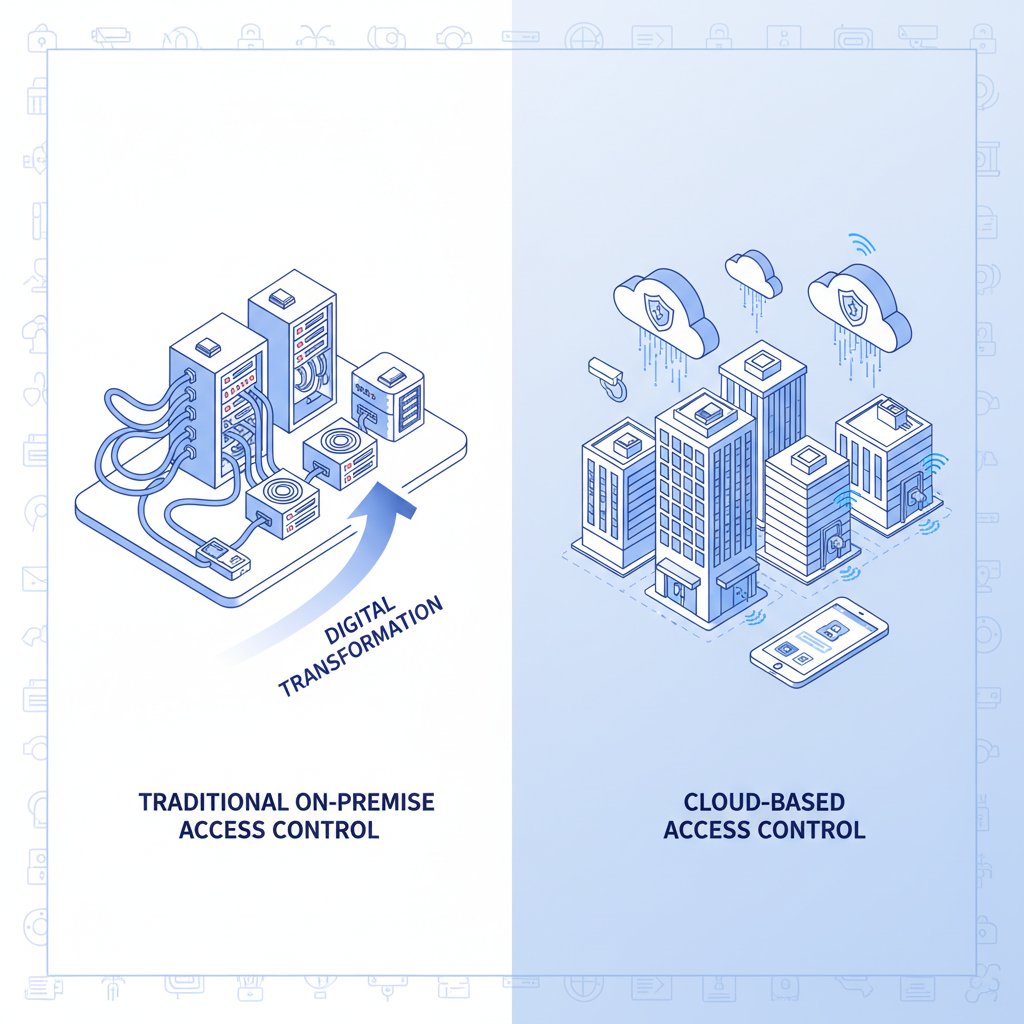
Cloud-based access control eliminates on-site servers entirely. Instead of housing physical hardware that stores credential databases, manages door schedules, and processes access events locally, the system operates through secure internet connectivity with data managed in professionally maintained data centers. When a resident uses their smartphone or key card to access a community amenity center in Boca Raton, authentication happens through encrypted cloud communication in milliseconds.
This architectural difference creates profound operational advantages. Property managers can grant temporary credentials to contractors from anywhere, security teams can investigate access events across multiple buildings simultaneously, and system updates happen automatically without scheduling technician visits. Companies like Brivo pioneered this approach in 1999, proving cloud architecture could deliver enterprise-grade security without the complexity of traditional systems.
Modern platforms from manufacturers like Verkada have expanded this concept further, integrating access control with cloud-based surveillance cameras, environmental sensors, and alarm systems into unified management dashboards. A single interface now controls what previously required three separate systems with different logins, different support contacts, and no communication between components.
Why South Florida Properties Are Accelerating Cloud Adoption in 2026
Hurricane Season and Remote Management Requirements
South Florida’s unique weather demands have made remote management capabilities critically important. When hurricane warnings force property management offices to close, cloud-based systems allow security oversight from any location with internet connectivity. During Hurricane season preparations, facility managers can verify that all exterior doors are secured, review camera footage of property conditions, and grant emergency access to storm preparation contractors—all without being physically present.
Traditional server-based systems require on-site presence for most management functions. If servers lose power or network connectivity during severe weather, access control often fails completely unless expensive backup systems are installed. Cloud-based access control with cellular failover maintains functionality even when primary internet connections are disrupted, a resilience factor that South Florida properties can’t ignore.
Multi-Site Property Management Efficiency
Real estate groups managing multiple properties throughout Southeast Florida face exponential complexity with traditional access control systems. Each property historically required separate servers, different software versions, and individual maintenance contracts. A property management company overseeing ten communities in Palm Beach County would need to log into ten different systems to complete basic administrative tasks.
Cloud-based access control consolidates multi-site management into single-pane-of-glass visibility. Corporate security directors can establish consistent policies across all properties, generate consolidated reports for insurance carriers, and coordinate vendor access across multiple locations simultaneously. When a maintenance contractor needs access to elevator machine rooms across five different buildings, temporary credentials can be created once and distributed instantly rather than coordinating with five different property managers.
Mobile Credentials and Resident Experience
The expectation for smartphone-based access has shifted from luxury amenity to baseline requirement, particularly in South Florida’s competitive rental markets. Luxury high-rises in Brickell and Aventura compete for residents who expect the same contactless, mobile-first experience they encounter everywhere else in their digital lives.
Cloud-based access control enables true mobile credentials through platforms like Brivo that transform smartphones into secure access devices. Residents download an app, receive encrypted credentials, and access parking garages, fitness centers, pool areas, and their residential floors without physical cards or fobs. When residents lose phones, credentials are revoked remotely in seconds—no rekeying, no card replacement fees, no security vulnerabilities from lost physical credentials floating around.
Visitor management becomes frictionless. Residents can send temporary digital credentials to guests with specific time restrictions. A dog walker receives Monday-Wednesday-Friday access to the service entrance between 10 AM and 2 PM, automatically expiring after the contract period ends. This granular control was technically possible with traditional systems but required expertise that made it effectively unavailable to most properties.
Integration With Property Management and Building Systems
Modern commercial properties operate as integrated technology ecosystems, not collections of isolated systems. Cloud-based access control connects with property management software, building automation systems, video surveillance platforms, and parking revenue control through open APIs (Application Programming Interfaces).
When new residents complete their lease signing in property management software, access credentials are automatically created and distributed without redundant data entry. When residents move out, their access permissions are automatically revoked. For hotels throughout Palm Beach County, systems like Verkada’s cloud platform integrate with property management systems so guest room access is automatically synchronized with reservation status—guests receive access at check-in time and lose it at checkout, with no front desk involvement required.
This integration extends to surveillance systems. When doors are accessed after designated hours, integrated security solutions automatically trigger camera recordings and send alerts to security personnel. Unauthorized access attempts create immediate video evidence rather than discovering problems during post-incident investigations. Fortress Global Technology specializes in these complex integrations across multiple manufacturers, ensuring different technology components communicate effectively rather than operating as disconnected tools.
Addressing Cloud Security Concerns: Why Cloud Is More Secure
Property decision-makers often express concern about cloud security, assuming on-premise servers offer better control. The reality inverts this assumption. Cloud-based access control platforms employ security infrastructure that individual properties cannot economically replicate.
Professional data centers maintain redundant power supplies, sophisticated intrusion detection, 24/7 security monitoring, and multi-factor authentication protocols. They employ dedicated security teams whose sole focus is protecting system integrity. Software updates addressing newly discovered vulnerabilities are deployed immediately across all installations simultaneously.
Traditional on-premise systems, by contrast, typically run outdated software versions because updates require scheduling technician visits and risking system downtime. Servers sit in unlocked IT closets or property management offices with minimal physical security. When security vulnerabilities are discovered, patches may not be applied for months—if ever. The server itself becomes a single point of failure and a concentrated security target.
Data encryption has become standard in modern cloud platforms. Credential data transmits through encrypted channels, and manufacturers like Brivo and Verkada implement bank-level encryption protocols. Even if someone intercepted communication, encrypted data remains useless without decryption keys that never leave secure data centers.
The Technology Behind Cloud-Based Access Control
System Architecture and Components
Understanding basic architecture helps property managers make informed decisions. Cloud-based access control systems consist of several components working together:
- Door Controllers: Intelligent devices installed at each access point that manage credential verification, door lock control, and communication with cloud servers
- Readers: Interface devices (card readers, smartphone readers, keypads) where users present credentials
- Credentials: Physical cards, key fobs, or mobile credentials that identify authorized users
- Cloud Platform: Hosted software managing user databases, access schedules, event logging, and system configuration
- Management Interface: Web browsers or mobile apps through which administrators control the system
Door controllers maintain local intelligence, storing credentials and access rules internally so doors continue functioning even if internet connectivity is temporarily lost. Once connectivity is restored, systems synchronize automatically with the cloud platform, uploading access events and downloading any configuration changes made during the outage.
Cellular Failover and Network Resilience
Advanced cloud access control systems incorporate cellular backup connectivity, particularly important for South Florida properties facing periodic network disruptions during severe weather. If primary internet connections fail, systems automatically switch to cellular networks maintained by providers like Velocity MSC, ensuring continuous operation without gaps in security coverage.
This redundancy would be prohibitively expensive with traditional systems requiring separate cellular modems for each on-premise server. Cloud architecture distributes this capability efficiently across entire property portfolios.
Real-World Applications: Cloud Access Control in South Florida Properties
Multi-Family Residential Communities
A 400-unit luxury apartment community in Delray Beach recently transitioned from traditional card access to Brivo’s cloud platform. The property management team now manages resident access, temporary contractor credentials, and amenity area scheduling from their smartphones. During the first six months, administrative time spent on access control decreased by 60 percent, while resident satisfaction scores increased measurably due to mobile credential convenience.
Package rooms have become critical amenity spaces requiring sophisticated access management. Cloud-based systems create audit trails showing exactly who accessed the package room and when, reducing theft concerns while eliminating the old practice of giving all residents keys to shared spaces.
Commercial Office Buildings
Class A office towers throughout downtown Fort Lauderdale and West Palm Beach use integrated security solutions combining cloud-based access control with elevator destination dispatch systems. Employees and visitors receive access to specific floor ranges based on their tenant affiliation, with the elevator automatically directed to appropriate floors after credential verification in the lobby.
Multi-tenant buildings benefit enormously from cloud systems’ ability to segment access permissions by tenant organization while maintaining centralized oversight for building management. When tenants expand or contract space, access permissions adjust instantly without physical lock changes or key redistribution.
Hotels and Hospitality Properties
South Florida hotels have embraced cloud-based access control integrated with property management systems. Beachfront resorts in Palm Beach deploy systems from Verkada that synchronize guest room access with reservation data, while providing separate access control for back-of-house areas like loading docks, employee entrances, and maintenance facilities.
The audit trail capabilities prove invaluable during investigations of guest property loss or security incidents. Hotels can instantly review who accessed specific floors or service areas during relevant timeframes, with access events automatically linked to video surveillance footage for comprehensive incident documentation.
Cost Considerations: Total Cost of Ownership Analysis
Cloud-based access control operates on subscription licensing rather than large upfront capital expenditures for servers and software licenses. This shift from capital expense to operational expense offers budget advantages, particularly for properties that previously faced unexpected replacement costs when servers failed or became obsolete.
Subscription fees typically include software updates, cloud hosting, data storage, and system support—costs that were separate line items with traditional systems. Properties avoid expensive server refresh cycles every five to seven years and eliminate dedicated IT infrastructure for access control management.
Professional installation remains essential regardless of system architecture. Complex properties benefit from working with licensed electrical contractors like Fortress Global Technology who handle complete installations from network infrastructure to final system configuration, ensuring reliable operation and code compliance that affects insurance coverage and liability protection.
Selecting the Right Cloud Access Control Platform
Not all cloud-based systems deliver equivalent capabilities or long-term reliability. Property managers should evaluate several factors:
- Manufacturer Stability: Established companies like Brivo (operating since 1999) and Verkada (backed by significant venture capital) provide confidence in long-term platform support
- Integration Capabilities: Open API platforms that connect with existing building systems, property management software, and video surveillance
- Scalability: Systems that accommodate property growth without architectural limitations or expensive upgrades
- Local Support Infrastructure: Authorized dealers with licensed technicians available throughout the system lifespan for service, expansion, and troubleshooting
- Cellular Failover Options: Backup connectivity for properties where access continuity is critical
- Mobile Credential Support: True smartphone-based access, not just web-based management
Working with experienced integrators who maintain manufacturer authorizations ensures access to technical support, warranty protection, and ongoing training on platform updates.
The Migration Process: Transitioning From Legacy Systems
Properties don’t need to replace all access control infrastructure simultaneously. Phased migration approaches allow gradual transition while maintaining security throughout the process. High-traffic areas like main entrances and amenity centers might convert first, with secondary access points following as budget permits.
Some door hardware may be reusable depending on existing system architecture, reducing total migration costs. Professional assessment by qualified integrators identifies which components can be retained and which require replacement for compatibility with modern cloud platforms.
During transitions, both old and new systems can operate simultaneously, eliminating security gaps. Properties maintain full control throughout the migration rather than facing the “all at once” pressure that delayed many cloud transitions in earlier years.
Future-Proofing: Cloud Access Control Evolution in 2026 and Beyond
Cloud architecture enables continuous capability enhancement without hardware replacement. Features that didn’t exist when systems were installed become available through software updates. Artificial intelligence and machine learning integration is emerging in platforms like Verkada, providing predictive analytics about access patterns, anomaly detection, and automated security responses.
As smart building technology evolves, cloud-based access control serves as the foundational identity layer that other systems reference. Lighting controls, HVAC systems, and parking management can all tie into access control identity verification, creating truly responsive environments that adjust based on occupancy and authorization status.
Properties investing in cloud infrastructure today position themselves to adopt these emerging capabilities seamlessly rather than facing another complete system replacement cycle.
Make the Strategic Move to Cloud-Based Access Control
The transition to cloud-based access control represents more than technology modernization—it’s a fundamental improvement in how South Florida properties manage security, operational efficiency, and resident experience. Properties delaying this transition increasingly face competitive disadvantages in tenant attraction, operational costs, and security effectiveness.
Fortress Global Technology has designed and installed comprehensive cloud-based access control systems throughout Southeast Florida since 2004, working with properties ranging from 200-unit residential communities to 300+ room hotels. As an authorized integrator for Brivo, Verkada, and other leading manufacturers, we provide the technical expertise, licensed installation capabilities, and ongoing local support that complex commercial properties require.
Our approach begins with understanding your property’s specific security requirements, operational workflows, and integration needs with existing building systems. We design customized solutions that address your unique challenges rather than offering one-size-fits-all packages. From initial consultation through installation, testing, training, and ongoing support, our local teams ensure your cloud-based access control system delivers reliable security and operational efficiency.
Contact Fortress Global Technology today to schedule a comprehensive security assessment for your South Florida property. Let’s discuss how cloud-based access control can enhance your security posture, reduce operational complexity, and prepare your property for the future of integrated security solutions. Call us or visit our website to connect with our team of licensed security technology professionals.