
Before investing in a new commercial security system, conducting a thorough physical security assessment is the single most critical step property managers overlook. A comprehensive evaluation identifies vulnerabilities, eliminates unnecessary spending on redundant technology, and creates a strategic roadmap that prioritizes actual risks rather than perceived threats. For large commercial properties—from 300-room hotels to 500-unit residential communities—skipping this essential planning phase often results in costly system redesigns, coverage gaps, and integration failures that undermine the entire security investment.
A professional security assessment examines your property through multiple lenses: physical vulnerabilities, operational workflows, existing infrastructure capabilities, and future scalability requirements. This consultative process transforms security from a reactive expense into a strategic asset that protects property value, reduces liability exposure, and improves operational efficiency across every aspect of facility management.
Why Commercial Properties Need Professional Security Assessments
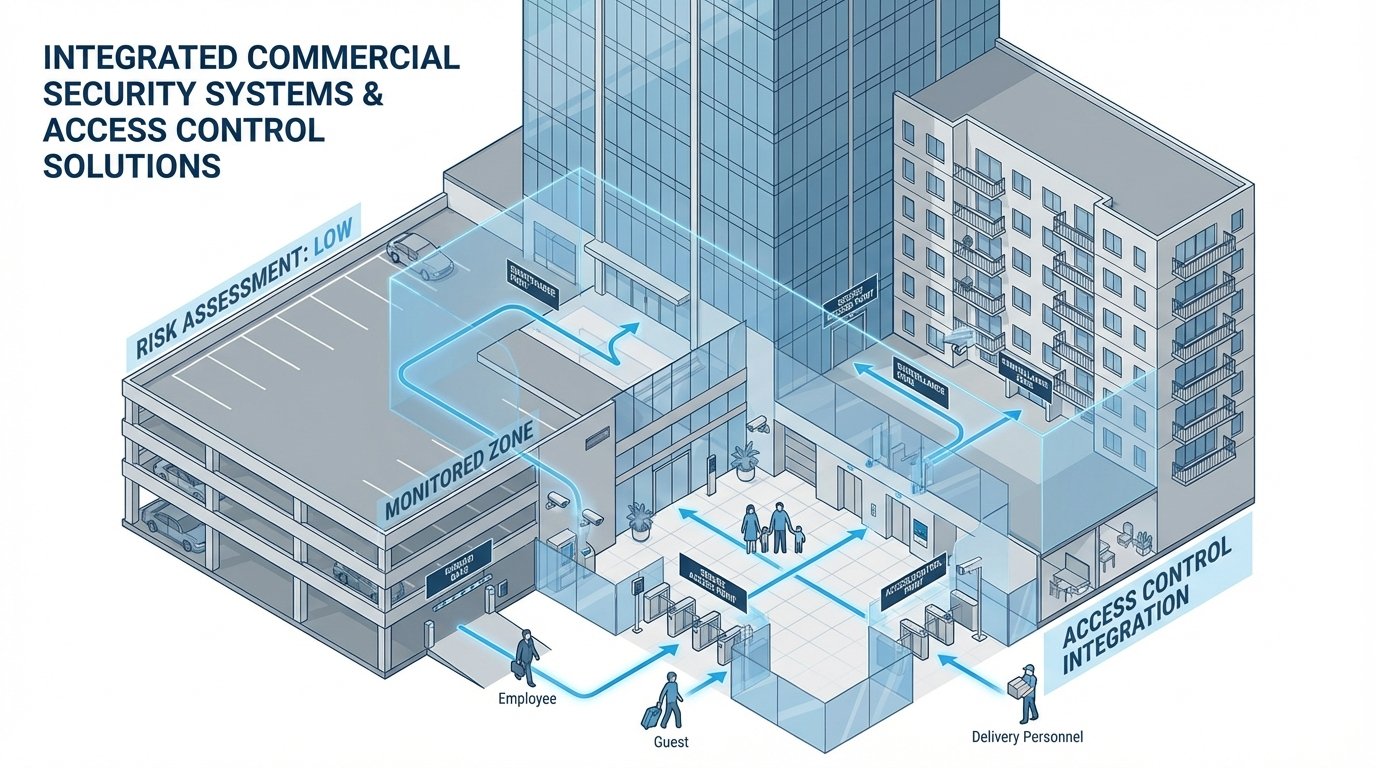
Large-scale properties face fundamentally different security challenges than residential homes or small businesses. A 200-unit multi-family community manages hundreds of residents, guests, service providers, and delivery personnel daily. Hotels coordinate guest access, employee schedules, parking validation, and loading dock operations simultaneously. Office buildings balance tenant privacy, shared amenity access, elevator control, and after-hours security across multiple floors and zones.
These complex environments require integrated security solutions that connect access control, surveillance cameras, visitor management, intercom systems, and intrusion detection into unified platforms. Without proper assessment, properties typically make three critical mistakes: purchasing disconnected systems that don’t communicate, overinvesting in technology for low-risk areas while underprotecting critical zones, or selecting equipment incompatible with existing network infrastructure.
Professional assessments conducted by licensed commercial security installation Florida experts prevent these expensive errors by mapping security technology to actual operational requirements rather than generic checklists.
The Complete Physical Security Assessment Process
Perimeter and Access Point Analysis
Every comprehensive security system begins at your property boundaries. Assessors systematically document all entry and exit points—vehicular gates, pedestrian doors, loading docks, emergency exits, and roof access. For parking facilities serving 500+ vehicles, this includes examining garage entrances, stairwell access, elevator lobbies, and payment kiosks.
This perimeter evaluation identifies high-traffic public entrances requiring robust visitor management versus restricted employee-only zones needing stricter access control. Assessors note physical vulnerabilities like poorly lit areas, blind spots invisible to existing cameras, and unsecured doors that compromise the entire security perimeter. For Florida properties, this analysis includes evaluating equipment exposure to salt air, humidity, and hurricane-force winds that demand weather-resistant installations.
Advanced perimeter security increasingly incorporates license plate recognition (LPR) systems from manufacturers like Axis Communications, which automatically log vehicles entering parking structures while triggering access control systems to verify authorization. This integration between surveillance and access creates security layers that function automatically rather than depending on manual monitoring.
Internal Zone Classification and Risk Assessment
Not all interior spaces require identical security measures. Professional assessments classify your property into security zones based on risk levels, traffic patterns, and asset values. Hotels separate public lobbies from guest corridors, back-of-house employee areas, and high-value storage zones. Office buildings distinguish between open collaborative spaces, individual tenant suites, executive floors, and sensitive IT infrastructure rooms.
Multi-family residential communities prioritize amenity centers, package rooms, fitness facilities, and parking garages where residents expect both security and convenience. Warehouses focus on inventory storage, loading docks, equipment areas, and perimeter fence lines where theft risks concentrate.
This zone-based approach allows custom security solutions that match protection levels to actual threats. Public areas might use Verkada cloud-based cameras with AI-powered people detection to monitor crowd flow and identify unusual behavior patterns. Restricted zones could implement Brivo mobile credentials that create audit trails documenting exactly who accessed sensitive areas and when. Executive floors might integrate Napco access control with elevator systems, preventing unauthorized users from even selecting protected floors.
Existing Infrastructure Evaluation
Modern security systems depend on robust network infrastructure that many older properties lack. Assessors evaluate existing cabling, network switches, power availability, and internet bandwidth to determine whether current infrastructure supports cloud-based platforms or requires substantial upgrades.
Properties built before 2010 often have outdated Category 5 cabling insufficient for today’s 4K surveillance cameras. Parking garages may lack proper conduit pathways for running new cables between multiple levels. Coastal properties might have corroded connection points requiring complete replacement.
For properties requiring comprehensive network upgrades, Fortress Global Technology partners with Velocity MSC to deliver managed IT solutions alongside security installations. This integrated approach ensures your network infrastructure can support not just today’s security requirements but future expansions as technology evolves and property needs grow.
Current System Performance Analysis
If your property has existing security equipment, assessors evaluate what’s worth preserving versus replacing entirely. Open-platform video management systems like Milestone XProtect can often integrate legacy cameras alongside new equipment, protecting previous investments while upgrading critical coverage areas.
This analysis examines camera coverage gaps, access control system limitations, and recording storage capacity. Are current cameras positioned to capture usable facial recognition, or merely confirm that “someone” entered? Does your access control system create audit trails that document facility access, or simply unlock doors? Can security staff quickly retrieve specific video footage, or do they waste hours searching through unindexed recordings?
Understanding current system capabilities and limitations informs upgrade strategies that prioritize high-impact improvements over wholesale replacements that may not be necessary.
Operational Workflow and Integration Requirements
The most sophisticated specialized commercial security solutions fail if they disrupt rather than enhance daily operations. Effective assessments examine how security technology intersects with property management workflows, employee scheduling, tenant move-ins, visitor processing, and emergency response procedures.
Access Control and Property Management Integration
Hotels require security systems that communicate directly with property management software (PMS). When guests check in, their room credentials should automatically activate. At checkout, access immediately deactivates. This seamless integration eliminates manual programming that creates security gaps and frustrates guests with malfunctioning key cards.
Multi-family communities benefit from similar integration between access control and lease management systems. When residents sign leases, their mobile credentials automatically provision access to apartment doors, amenity centers, parking garages, and elevator systems. When leases end, all access privileges automatically revoke without property managers manually updating multiple systems.
Brivo’s cloud-based platform excels in these scenarios, offering pre-built integrations with major property management software platforms that reduce administrative workload while improving security compliance.
Visitor Management and Temporary Credentials
Commercial properties manage constant visitor flow—hotel guests, office building clients, residential community guests, warehouse delivery drivers, and maintenance contractors. Assessment processes examine how properties currently handle visitor authorization and identify opportunities for improvement.
Modern visitor management systems issue temporary mobile credentials or QR codes that provide time-limited access to specific areas. Delivery drivers receive loading dock access valid only during scheduled windows. Contractors get credentials that work exclusively in renovation zones rather than throughout entire buildings. Hotel guests access only their floor via elevator integration that prevents unauthorized floor selection.
These granular access controls dramatically reduce security risks while improving operational efficiency. Property managers spend less time distributing physical keys or manually programming temporary access cards, and security teams maintain complete audit trails documenting exactly who accessed which areas when.
Emergency Response and Life Safety Integration
Security systems must coordinate with fire alarms, emergency exit protocols, and first responder access requirements. Assessors verify that access control systems automatically unlock doors during fire alarms, preventing occupants from being trapped. They ensure surveillance cameras cover all emergency exits to document evacuations and identify potential safety hazards.
For high-rise residential and office buildings, this includes examining elevator recall functionality during emergencies and verifying that emergency responders can override access control systems to reach any floor or area immediately.
Technology Selection Based on Assessment Findings
With comprehensive assessment data, security professionals recommend specific technologies matched to documented requirements rather than generic product catalogs. This consultative approach explains why Fortress Global Technology partners with multiple leading manufacturers rather than pushing single-brand solutions regardless of actual needs.
Cloud-Based Versus On-Premise Systems
Properties with strong IT departments and existing server infrastructure might prefer on-premise systems offering complete data control. Verkada’s hybrid cloud approach stores video footage on camera-mounted storage while providing cloud-based management interfaces that eliminate dedicated server requirements—ideal for properties wanting cloud convenience without complete dependency on internet connectivity.
Multi-location enterprises managing hotels, office buildings, or residential communities across different cities benefit enormously from 100% cloud platforms like Brivo that centralize access control management. Regional managers can provision credentials, review access logs, and modify permissions across entire property portfolios from single dashboards rather than traveling to individual sites.
Camera Selection for Specific Applications
Parking garage surveillance requires different camera technology than office lobby monitoring. Axis Communications offers specialized cameras optimized for various applications—thermal imaging for perimeter detection, 4K resolution for facial recognition in controlled access points, wide-angle models for parking lot overviews, and specialized low-light cameras for overnight monitoring.
Hanwha Vision’s Wisenet AI cameras provide advanced analytics that transform cameras from passive recording devices into proactive security tools. These systems detect loitering, recognize when individuals enter restricted zones, identify abandoned objects, and count occupancy in amenity spaces—all without human monitoring.
Assessment findings determine which locations need basic motion-triggered recording versus sophisticated AI analytics, optimizing budget allocation for maximum security impact.
Creating the Security System Implementation Roadmap
Professional assessments conclude with prioritized implementation roadmaps that phase installations based on risk levels, budget constraints, and operational requirements. This strategic planning prevents the common mistake of installing entire systems simultaneously, which disrupts operations and strains budgets.
Phase One: Critical Vulnerabilities
Initial phases address documented high-risk areas—unsecured entrances, parking structures with theft histories, or loading docks lacking access controls. These immediate improvements deliver measurable security enhancements while building confidence in the overall system plan.
Phase Two: Integration and Efficiency
Subsequent phases connect previously isolated systems into comprehensive security systems that share data and coordinate responses. Access control systems begin triggering camera recordings. Intercom systems integrate with mobile credentials. Visitor management connects with parking validation.
Phase Three: Enhanced Capabilities and Expansion
Final phases add advanced features like AI analytics, expanded camera coverage in lower-risk areas, and integration with property management or building automation systems. This phased approach spreads costs over multiple budget cycles while continuously improving security posture.
The Value of Licensed Professional Installation
DIY security installations or unlicensed contractors cannot deliver the integrated solutions that large commercial properties require. Fortress Global Technology operates as a licensed electrical contractor capable of handling complete installations from low-voltage cabling and network infrastructure to final system configuration and ongoing support.
This comprehensive capability ensures that security systems receive proper power supplies with battery backup, network infrastructure with appropriate bandwidth and redundancy, weatherproof outdoor installations meeting Florida building codes, and complete documentation for future maintenance and expansion.
Licensed installation also protects equipment warranties, ensures code compliance that prevents expensive violations, and provides ongoing local support throughout system lifespans rather than installation-and-goodbye service that leaves properties stranded when problems arise.
Start Your Security Assessment Today
Whether you manage a 300-room hotel in Palm Beach County, a 500-unit residential community in Fort Lauderdale, or a Class A office tower in Manhattan, professional security assessment is the foundation for effective protection. This consultative process identifies actual vulnerabilities, recommends integrated security solutions tailored to your operational requirements, and creates implementation roadmaps that maximize security value while respecting budget realities.
Fortress Global Technology has conducted security assessments for large-scale commercial properties nationwide since 2004. Our licensed teams evaluate your complete property environment, recommend appropriate technologies from our partnerships with Verkada, Brivo, Axis Communications, Hanwha Vision, and other industry leaders, and deliver turnkey installations backed by ongoing local support.
Contact Fortress Global Technology today to schedule your comprehensive security assessment and discover how integrated access control, surveillance, and visitor management systems can protect your property investment while improving operational efficiency throughout your facility.