
A South Florida hotel recently faced a lawsuit when they couldn’t produce surveillance footage from an incident that occurred 45 days earlier—their system automatically overwrote files after 30 days. The case was dismissed due to lack of evidence, but not before costing the property thousands in legal fees and damaging their reputation. This scenario plays out repeatedly across commercial properties when video retention policies don’t align with legal requirements and business needs.
Understanding video retention requirements isn’t just about compliance—it’s about protecting your property investment, defending against liability claims, and maintaining operational records that can prove invaluable when disputes arise. For commercial properties in Florida, establishing appropriate retention policies requires balancing legal obligations, storage costs, privacy concerns, and practical business needs.
Florida’s Legal Framework for Video Surveillance Retention
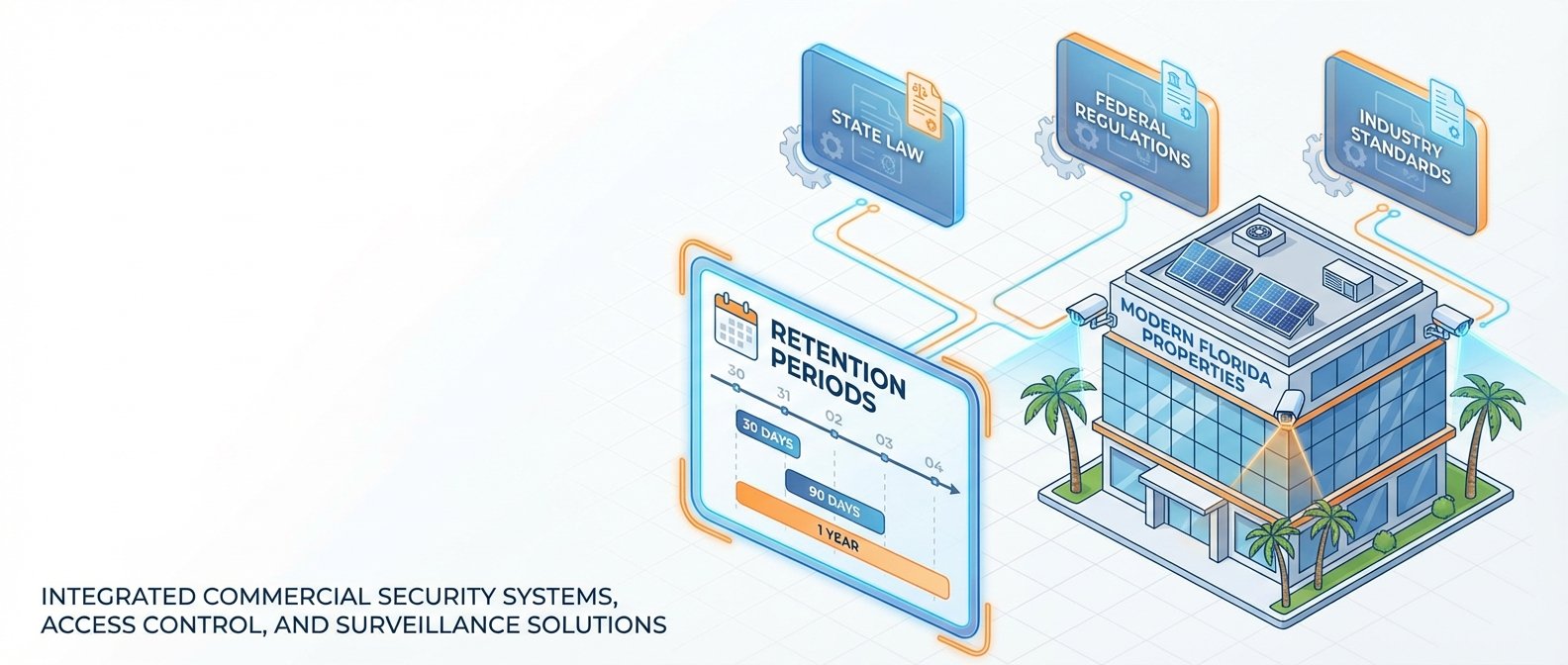
Florida doesn’t mandate specific retention periods for most private commercial properties, but this absence of prescriptive rules doesn’t mean property owners have complete discretion. Multiple legal frameworks influence how long your commercial video surveillance footage should be retained.
Civil Litigation Considerations
Florida’s statute of limitations for negligence claims is four years, while premises liability cases must be filed within four years of the incident. Once litigation is anticipated or filed, properties have a legal obligation to preserve relevant evidence—including surveillance footage—under Florida’s civil procedure rules. Destroying footage after receiving notice of a potential claim can result in spoliation sanctions, adverse jury instructions, or case dismissal in your opponent’s favor.
This creates a practical minimum retention period of at least 90 days for most commercial properties. Most incidents aren’t reported immediately, and claimants often don’t notify property owners until weeks or months after an event. A 30-day retention policy leaves properties vulnerable when a slip-and-fall victim contacts an attorney 45 days after their incident.
Industry-Specific Requirements
Certain Florida commercial properties face specific retention mandates. Healthcare facilities subject to HIPAA regulations should retain footage for at least six years. Properties accepting payment cards must comply with PCI-DSS standards, which recommend 90 days minimum for areas where cardholder data is processed. Properties with government contracts or federal tenants may face retention requirements ranging from three to seven years.
Multi-family residential communities, hotels, and commercial office buildings don’t face industry-specific mandates, but they do face significant liability exposure that makes longer retention periods prudent. Fortress Global Technology works with properties throughout Palm Beach County, Broward County, and Miami-Dade County to establish retention policies that address their specific risk profiles.
Recommended Retention Periods by Property Type
While legal minimums establish floors, optimal retention periods depend on your property type, common liability exposures, and available storage capacity.
Multi-Family Residential Communities
For apartment complexes and condominium associations with 200+ units, we typically recommend 90 to 180 days for common areas including lobbies, parking garages, pools, and amenity centers. Elevator cameras and entry points where access control integration creates audit trails can follow the same schedule. Package room footage might warrant shorter retention (30-60 days) given the volume of daily activity and lower liability exposure.
A luxury high-rise in Brickell recently benefited from their 120-day retention policy when a resident claimed their vehicle was damaged in the parking garage 75 days prior. The footage definitively showed the damage occurred off-property, saving the HOA from an expensive claim and potential insurance rate increase.
Hotels and Hospitality Properties
Hotels face unique retention challenges given the volume of guests and transient nature of potential claimants. We recommend 120 to 180 days for public areas, parking facilities, and perimeter cameras. Back-of-house areas like loading docks and employee-only spaces can typically retain footage for 60 to 90 days.
Hotels using integrated security systems that link Verkada cloud-based cameras with Brivo access control can create powerful audit trails showing exactly who accessed restricted areas and when. This integration becomes especially valuable for investigating theft claims or employee incidents.
Commercial Office Buildings
Class A office towers and corporate campuses should maintain 90 to 180 days of footage for lobbies, parking structures, and perimeter areas. Elevator cameras in buildings with floor-by-level access control integration provide both security and operational records. Loading dock footage helps resolve vendor disputes and should be retained for at least 90 days.
One corporate campus in Palm Beach Gardens discovered the value of extended retention when investigating a series of thefts that occurred over a three-month period. Their 180-day retention policy allowed security to review patterns and identify the perpetrator using footage that would have been overwritten under a shorter policy.
Retail and Shopping Centers
Retail properties should retain parking lot and perimeter surveillance for 90 to 180 days given slip-and-fall liability and vehicle accident claims. Interior common areas follow similar timelines. Individual tenant spaces fall under tenant control, though property owners should establish minimum standards in lease agreements.
Parking Facilities and Garages
Standalone parking structures with 500+ spaces face substantial liability exposure from vehicle damage claims, personal injury incidents, and criminal activity. We recommend 120 to 180 days retention for all cameras. License plate recognition systems integrated with access control create additional audit trails that should follow the same retention schedule.
Storage Capacity and Technology Considerations
Retention policies must align with available storage capacity. Modern IP security cameras commercial installations offer multiple storage architectures, each with different cost and performance characteristics.
Hybrid Cloud Solutions
Verkada cameras feature onboard storage (typically 30-365 days depending on camera model and recording settings) with cloud backup for critical footage. This hybrid approach provides extended retention without expensive centralized storage infrastructure. Properties can retain standard footage for 30-90 days on-device while flagging important incidents for cloud retention extending to one year or more.
This architecture works exceptionally well for multi-site enterprises and properties with limited IT infrastructure. A hotel chain with properties throughout South Florida uses Verkada’s platform to maintain consistent 120-day retention across all locations without managing on-premise servers at each property.
On-Premise Network Video Recorders
Traditional commercial video surveillance systems using Axis Communications or Hanwha Vision cameras with centralized recording require careful storage planning. A 200-camera system recording at 1080p resolution with moderate motion typically generates 8-15TB of data monthly. Retaining 180 days of footage requires 48-90TB of storage capacity, plus redundancy for system reliability.
However, on-premise systems offer advantages for properties requiring guaranteed retention without internet dependency. Warehouses and distribution centers often prefer this architecture to maintain complete control over footage and avoid cloud subscription costs.
Video Management System Flexibility
Properties using Milestone XProtect VMS gain tremendous flexibility in retention policies. Different camera groups can follow different schedules based on risk assessment. High-traffic lobbies might retain 180 days while back corridors retain 60 days. Motion-based recording extends retention by capturing only relevant activity rather than continuous footage.
This granular control optimizes storage costs while maintaining appropriate retention where it matters most. A mixed-use development in Fort Lauderdale uses Milestone to manage retention across residential lobbies (180 days), retail parking (120 days), and service corridors (60 days) from a single platform.
Balancing Privacy and Retention Requirements
Florida law requires posted notice when video surveillance is in use on private property. While extended retention serves legitimate business interests, properties must also consider privacy implications and data security obligations.
Establish clear policies governing who can access footage and under what circumstances. Modern commercial security camera installation should include role-based access controls limiting video access to authorized personnel. Audit logs tracking who viewed what footage and when provide accountability and help defend against privacy complaints.
For multi-family residential properties, consider limiting retention in highly sensitive areas. Pool and amenity cameras might justify shorter retention than parking garages given the privacy expectations of residents in recreational areas.
Implementing Litigation Hold Procedures
Even well-designed retention policies require override procedures when litigation is anticipated. Properties should establish clear protocols for preserving footage when incidents occur or claims are threatened.
When a guest slips in your hotel lobby or a resident reports a vehicle burglary, immediately flag that footage for extended retention. Modern systems like Verkada’s Command platform make this simple—authorized users can tag incidents from any device, preventing automatic deletion and preserving evidence.
Train property managers and security staff to recognize situations requiring litigation holds: any injury on property, significant property damage, police reports, written complaints, or contact from attorneys. Create a simple reporting form that triggers footage preservation and notifies your legal team.
Integration with Access Control Creates Comprehensive Records
The most effective retention strategies extend beyond video to encompass integrated security data. When Brivo access control systems communicate with surveillance cameras, every door opening generates both an access log and corresponding video clip. These integrated records prove invaluable for investigations.
A commercial office building in Boca Raton recently investigated unauthorized after-hours access to an executive suite. Their integrated system showed credential use at 2:47 AM, automatically pulled corresponding camera footage, and revealed an employee had shared credentials with an unauthorized individual. Without integration, correlating access logs with video would have required hours of manual review.
Access control data is compact and inexpensive to retain indefinitely. We recommend retaining access logs for at least the same period as video footage, with many properties keeping access records for years given minimal storage requirements.
Establishing Your Retention Policy
Creating an appropriate retention policy requires assessing your specific property characteristics, liability exposure, storage capacity, and regulatory requirements. Consider these factors:
- Property type and primary liability exposures: Hotels face different risks than office buildings or warehouses
- Historical claim patterns: Review insurance claims from the past five years to understand typical timelines between incidents and claim filing
- Available storage capacity: Current infrastructure may limit options or require upgrades to support extended retention
- Budget constraints: Longer retention requires more storage, but storage costs have declined dramatically with modern systems
- Industry requirements: Healthcare, payment processing, and government contractors face specific mandates
- Multi-site consistency: Enterprises with multiple properties benefit from standardized policies
Document your retention policy formally and train all personnel with video system access. Include procedures for litigation holds, privacy protections, access controls, and periodic policy review.
Technology Upgrades to Support Extended Retention
Properties with legacy analog or early IP systems may find extended retention impractical with current infrastructure. This often signals the right time for a business cctv installation upgrade to modern platforms that dramatically improve storage efficiency.
Contemporary cameras from Hanwha Vision and Axis Communications use H.265 compression reducing file sizes by 50% compared to older H.264 systems without quality loss. Smart compression algorithms further reduce storage by varying quality based on activity levels—higher quality during motion, reduced quality during static scenes.
Motion-based recording captures only relevant activity rather than continuous footage of empty corridors, potentially extending retention periods by 3-5x without additional storage investment. However, continuous recording remains appropriate for high-security areas and locations with constant activity.
Working with Professional Integrators
Establishing optimal retention policies requires understanding both legal requirements and technology capabilities. Fortress Global Technology works with commercial properties throughout South Florida to design commercial security camera installation systems that balance retention requirements with practical constraints.
As a licensed electrical contractor, we handle complete installations from low-voltage cabling and network infrastructure to final system configuration. Our experience with massive properties including hotels, office complexes, and multi-family residential communities throughout Palm Beach County, Broward County, and Miami-Dade County gives us deep insight into retention challenges specific to South Florida commercial properties.
We’re authorized partners with leading manufacturers including Verkada, Axis Communications, Hanwha Vision, and Milestone Systems, allowing us to recommend solutions based on your specific needs rather than forcing one-size-fits-all approaches. Whether you need cloud-based systems for multi-site management or on-premise solutions for maximum control, we design retention-capable systems that protect your property and defend against liability.
Frequently Asked Questions
What happens if we delete footage we later need for litigation?
If deletion occurred before you had notice of potential litigation and followed your established retention policy, you’re generally protected. However, destroying footage after receiving notice of a claim or incident can result in spoliation sanctions including adverse jury instructions, evidence exclusion, or case dismissal. This makes litigation hold procedures essential.
Can we retain footage indefinitely to avoid any risk?
While technically possible with sufficient storage, indefinite retention creates privacy concerns, increases data breach exposure, and may complicate compliance with data protection regulations. Most properties find 90-180 days balances protection with practical considerations.
Do we need to tell people we’re recording and how long we retain footage?
Florida law requires posting notice that video surveillance is in use. While you’re not required to specify retention periods in signage, having a documented policy helps demonstrate good-faith compliance with privacy expectations and legal obligations.
How do cloud storage costs compare to on-premise systems for extended retention?
Cloud storage typically involves predictable monthly per-camera fees while on-premise requires upfront infrastructure investment. For properties with 50+ cameras and extended retention needs, on-premise often proves more economical long-term. Smaller properties or those wanting to avoid infrastructure management often prefer cloud economics. We analyze both options during system design based on your specific requirements.
Protect Your Property with Appropriate Retention Policies
Video retention policies represent an often-overlooked aspect of commercial property security that can prove decisive when liability claims arise. Establishing appropriate retention periods, implementing proper technology infrastructure, and training staff on litigation hold procedures protects your property investment and defends against costly claims.
Fortress Global Technology specializes in designing south florida security installation systems that support your retention requirements while remaining manageable and cost-effective. Our team has implemented commercial video surveillance solutions for hundreds of large properties throughout South Florida, and we understand the unique challenges facing hotels, multi-family communities, office buildings, and commercial properties in our region.
Contact us today for a consultation on your property’s video retention strategy and security system infrastructure. We’ll assess your current capabilities, identify vulnerabilities, and design a comprehensive solution that protects your property for years to come.