

When a major hotel in Boca Raton experienced access control failures across three buildings during peak season, the property manager discovered their maintenance contract covered only camera systems—not the integrated access platform controlling 400 guest rooms. The scramble to find emergency support cost three times what comprehensive preventive maintenance would have, plus immeasurable reputation damage from locked-out guests. This scenario plays out repeatedly across South Florida commercial properties that view security system maintenance as optional rather than essential infrastructure protection.
Security system maintenance contracts serve as insurance policies for the complex technology protecting your property investment. While initial installation captures attention and budget, the ongoing performance, reliability, and legal compliance of integrated security ecosystems depend entirely on structured maintenance programs. For South Florida properties managing access control systems, surveillance networks, and integrated platforms, understanding what belongs in a comprehensive maintenance agreement determines whether your security infrastructure protects or fails you.
Why South Florida Properties Require Specialized Maintenance Approaches
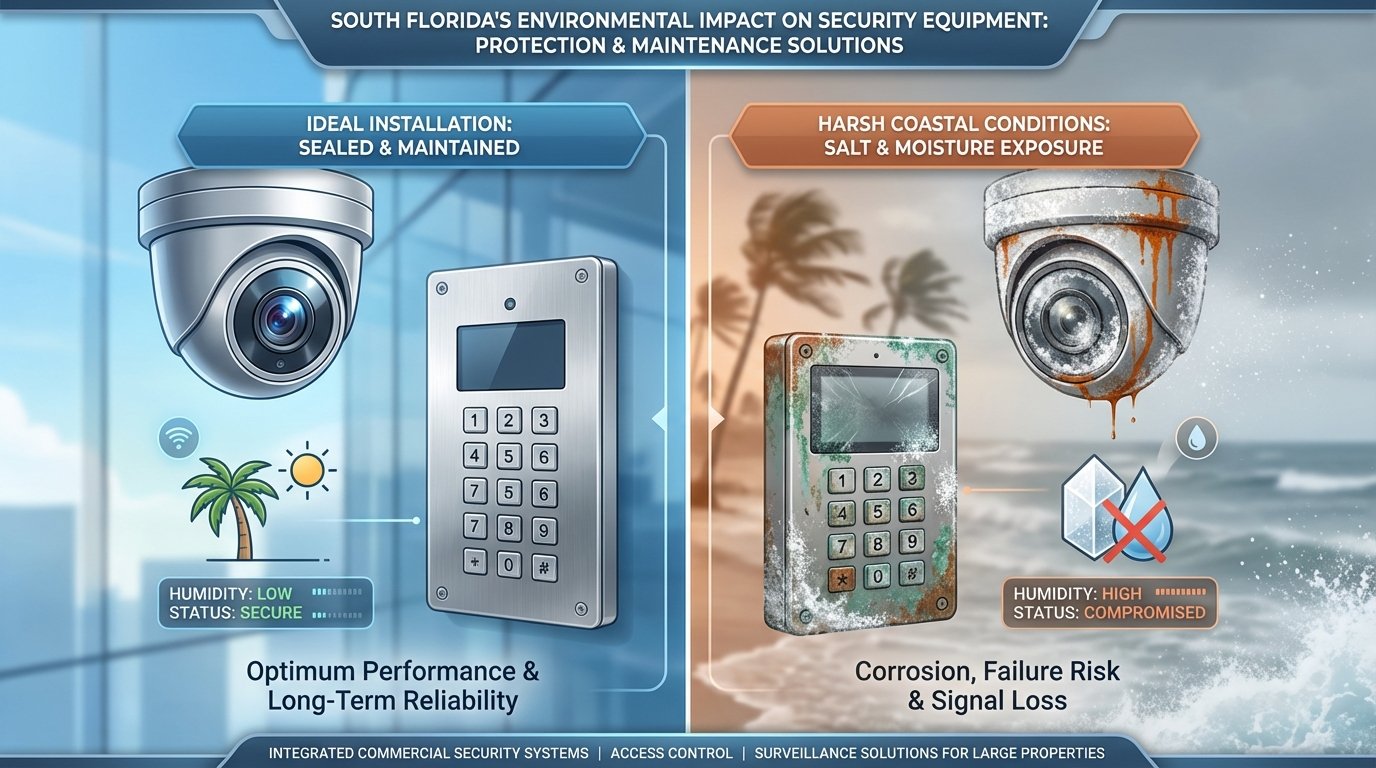
South Florida’s environmental conditions create unique challenges that make maintenance contracts fundamentally different from those in other regions. Salt air from coastal proximity corrodes camera housings and access control readers. Humidity levels that routinely exceed 80% threaten electronic components and network connections. Lightning strikes—Florida experiences more than any other state—can damage entire security networks through power surges. Hurricane season brings wind-driven rain that tests every outdoor installation’s weatherproofing. These conditions mean equipment rated for ten-year lifespans elsewhere may deteriorate in five without proper maintenance.
Commercial properties from West Palm Beach to Miami face additional operational pressures. Multi-family residential communities with 300+ units cannot afford access control downtime that leaves residents unable to enter parking garages or amenity centers. Hotels managing thousands of daily access events need surveillance systems recording continuously for liability protection. Office buildings with multi-tenant access requirements must maintain elevator integration and after-hours protocols without interruption. When security infrastructure fails in these environments, the consequences extend beyond inconvenience to legal liability, insurance implications, and revenue loss.
Core Components Every South Florida Security Maintenance Contract Must Include
Comprehensive System Coverage Across All Integrated Technologies
Effective maintenance contracts cover every component in your security ecosystem, not just individual products. Your access control systems, surveillance cameras, video management platforms, intercom systems, and network infrastructure function as interconnected layers. When contracts cover only cameras but exclude access control panels, or include hardware but not software updates, gaps in coverage create vulnerabilities.
For properties using integrated platforms like Verkada’s Command system that unifies cameras, access control, and alarms, maintenance contracts must address the entire ecosystem. Cloud-based systems require different maintenance approaches than on-premise solutions, focusing on network connectivity, bandwidth adequacy, and software version management rather than just hardware inspection. Properties running Brivo cloud access control alongside Axis Communications surveillance need maintenance programs that ensure both systems communicate properly and that integration points remain functional.
Preventive Maintenance Schedules With Environmental Adaptations
Preventive maintenance security programs distinguish professional contracts from basic “break-fix” agreements. Scheduled inspections catch problems before they cause system failures. For South Florida commercial security systems, quarterly inspections should be considered minimum frequency, with monthly checks for mission-critical systems or harsh coastal environments.
Preventive maintenance visits should include camera lens cleaning—critical when salt spray and pollen reduce image clarity, cleaning and testing of access control readers exposed to weather, verification of all cable connections and weatherproofing integrity, testing of backup power systems and battery health, network infrastructure performance testing, software and firmware updates across all platforms, and review of system logs for error patterns indicating emerging problems.
Properties using advanced analytics from Hanwha Vision Wisenet cameras or Verkada’s AI-powered detection need maintenance protocols that verify analytic accuracy and recalibrate detection zones after any camera adjustment. Milestone Systems video management platforms running large camera networks require database optimization and storage management as part of regular maintenance cycles.
Emergency Response Guarantees With Realistic Timeframes
Security system failures rarely happen during business hours. Access control malfunctions at 11 PM on Saturday create immediate crises for multi-family properties. Surveillance system failures during overnight hours leave properties unprotected during high-risk periods. Maintenance contracts must specify emergency response commitments with realistic, enforceable timeframes.
For South Florida properties, same-day response for critical failures should be standard, with 2-4 hour response times for properties with local support teams. Critical systems—those affecting life safety, property access, or high-value areas—warrant faster response than non-essential cameras. Contracts should define what constitutes “critical” versus “non-critical” failures and specify different response commitments for each category.
Geographic coverage matters significantly. A maintenance contract with a provider based in Orlando offers little value to a Miami Beach hotel when emergency response requires three-hour drives. Fortress Global Technology’s local teams throughout Palm Beach, Broward, and Miami-Dade counties provide response advantages that distant providers cannot match, particularly during hurricane seasons when travel becomes difficult.
Software Updates and Cybersecurity Patch Management
Modern security systems run sophisticated software requiring regular updates for functionality, compatibility, and cybersecurity protection. Access control platforms like Brivo and Continental by Napco Security Technologies release regular updates adding features and patching vulnerabilities. Video management systems like Milestone XProtect require updates to maintain compatibility with new camera models and operating system versions. Network cameras from Axis Communications receive firmware updates addressing security vulnerabilities and improving performance.
Maintenance contracts must include systematic software and firmware update management. This means monitoring for available updates, testing updates in controlled environments before deployment, scheduling updates during low-impact windows, and maintaining rollback capabilities if updates cause problems. For properties with IT infrastructure managed by partners like Velocity MSC, security maintenance contracts should coordinate with IT teams to ensure updates don’t conflict with network policies or other systems.
Cybersecurity has become inseparable from security system maintenance. Unpatched security systems create network vulnerabilities that sophisticated attackers exploit. Properties subject to data protection requirements—hotels storing guest information, medical offices within mixed-use properties, or any organization handling sensitive data—face regulatory obligations to maintain security system cybersecurity through regular patching and updates.
Contract Terms That Protect Your Investment
Clear Scope Definitions Preventing Surprise Charges
Ambiguous contract language creates disputes when maintenance needs arise. Effective contracts specify exactly what’s covered and what constitutes additional charges. Does “camera maintenance” include cleaning, adjustments, and minor repairs, or only inspection? Are replacement parts included up to certain dollar amounts, or does every component carry additional charges? Does network infrastructure supporting security systems fall within scope?
For large commercial properties, contracts should specify coverage by system type rather than generic terms. Access control coverage should explicitly include controllers, readers, locks, power supplies, and management software. Surveillance coverage should address cameras, recording servers, storage systems, video management software, and network switches dedicated to camera traffic. Integration points between systems warrant specific mention since these connection points often create finger-pointing when problems arise.
Performance Standards and Service Level Agreements
Maintenance contracts should commit providers to measurable performance standards. System uptime percentages—commonly 99% or higher for critical systems—create accountability. Response time commitments need specificity: “prompt response” means nothing, while “on-site within 4 hours for critical failures during business hours, within 8 hours after hours” creates enforceable obligations.
Regular reporting provides visibility into maintenance activities and system health. Quarterly reports should document all maintenance visits, issues identified and resolved, system performance metrics, recommended improvements or upgrades, and compliance with maintenance schedules. These reports serve multiple purposes: proving maintenance occurred for warranty and insurance purposes, identifying patterns suggesting equipment problems, supporting capital planning for future upgrades, and documenting due diligence for liability protection.
Contract Duration and Renewal Terms
Security system maintenance requires continuity. Providers familiar with your specific installation, configuration, and history deliver more effective service than those encountering your systems for the first time during emergencies. This argues for multi-year contracts that balance commitment with flexibility.
Three-year terms with annual price adjustment provisions work well for most commercial properties, providing stability while preventing providers from locking clients into outdated pricing. Contracts should include clear termination provisions protecting both parties: properties shouldn’t face punitive charges for reasonable termination, but providers deserve protection from clients who cancel immediately after expensive repairs.
Renewal terms matter as much as initial contracts. Automatic renewal clauses with 90-day cancellation notice periods prevent coverage gaps but require active management. Price escalation limits—caps on annual increases tied to indexes like CPI—prevent surprise cost jumps at renewal.
Specialized Considerations for Different Property Types
Multi-Family Residential Communities
Communities with 200+ units face unique maintenance priorities. Access control systems managing thousands of credentials require database maintenance and regular auditing. Amenity area cameras and access points experience heavy use requiring more frequent inspection. Package room access systems need particular attention since failures create immediate resident complaints. Contracts should specify resident communication protocols when maintenance requires temporary system disruptions.
Hotels and Hospitality Properties
Hotels cannot afford access control failures affecting guest rooms or surveillance gaps in liability-sensitive areas like parking structures and pools. Maintenance contracts should prioritize integration points with property management systems—when these connections fail, guest check-in and room access break down. Loading dock security and back-of-house access control warrant particular attention since these areas face constant use. Contracts should include provisions for rapid response during peak occupancy periods when problems have maximum impact.
Commercial Office Buildings
Multi-tenant office properties need maintenance approaches that minimize business disruption. Elevator integration with access control requires specialized expertise and careful testing. After-hours access management systems for cleaning crews and late-working tenants must function reliably. Contracts should address tenant communication requirements and specify maintenance windows that avoid business hours.
Cost Structures and Budget Planning
Security system maintenance contracts typically cost 12-20% of original installation value annually, varying based on system complexity, equipment age, and service level commitments. Properties with newer systems and comprehensive coverage pay toward the lower end; older systems or those requiring premium response times cost more.
This investment delivers measurable returns. Preventive maintenance extends equipment lifespan, potentially delaying costly replacements by years. Early problem detection prevents minor issues from becoming expensive failures. Maintained systems deliver better performance—clearer images, faster access response, fewer false alarms. Perhaps most significantly, comprehensive maintenance contracts provide budget predictability, converting unpredictable repair costs into manageable monthly expenses.
Properties should budget separately for maintenance contracts versus system upgrades. Maintenance preserves existing system functionality; upgrades add new capabilities or replace obsolete equipment. Mixing these budget lines creates confusion and can lead to deferred maintenance when upgrade projects consume available funds.
Questions to Ask Before Signing
Before committing to maintenance contracts, property decision-makers should verify several critical points. Confirm the provider holds appropriate licensing—in Florida, electrical contractor licenses for companies performing installation and maintenance of low-voltage security systems. Ask for client references from similar property types and sizes. Understand exactly who responds to service calls: employee technicians or subcontractors? Review the provider’s local presence and average response times in your specific area.
Clarify parts coverage explicitly. Are replacement components included up to certain dollar amounts, or does every part carry additional charges? Understand what happens when equipment becomes obsolete or irreparable—does the contract address replacement, or are you on your own? Ask how the provider stays current with cybersecurity threats and update requirements across different platforms.
Partner With South Florida Security Installation Experts
Security system maintenance contracts represent ongoing partnerships, not one-time transactions. The provider you select should bring deep expertise across the integrated technologies protecting your property, maintain local support teams available when you need them, demonstrate commitment to keeping your systems current and secure, and understand the specific challenges South Florida environments create.
Fortress Global Technology has maintained complex security ecosystems for South Florida’s largest commercial properties since 2004. As a licensed electrical contractor and authorized integrator for Verkada, Brivo, Axis Communications, Hanwha Vision, Napco Security Technologies, Milestone Systems, and Velocity MSC, we design maintenance programs as comprehensive as the integrated security solutions we install. Our teams throughout Palm Beach, Broward, and Miami-Dade counties deliver the responsive, expert support that keeps your security infrastructure protecting your property investment.
Don’t wait for system failures to discover the gaps in your maintenance coverage. Contact Fortress Global Technology today for a comprehensive security system maintenance assessment. We’ll review your existing infrastructure, identify vulnerabilities in current maintenance approaches, and design a preventive maintenance security program that matches your property’s specific requirements and risk profile. Protect your investment with maintenance contracts built for South Florida’s demanding environment.