
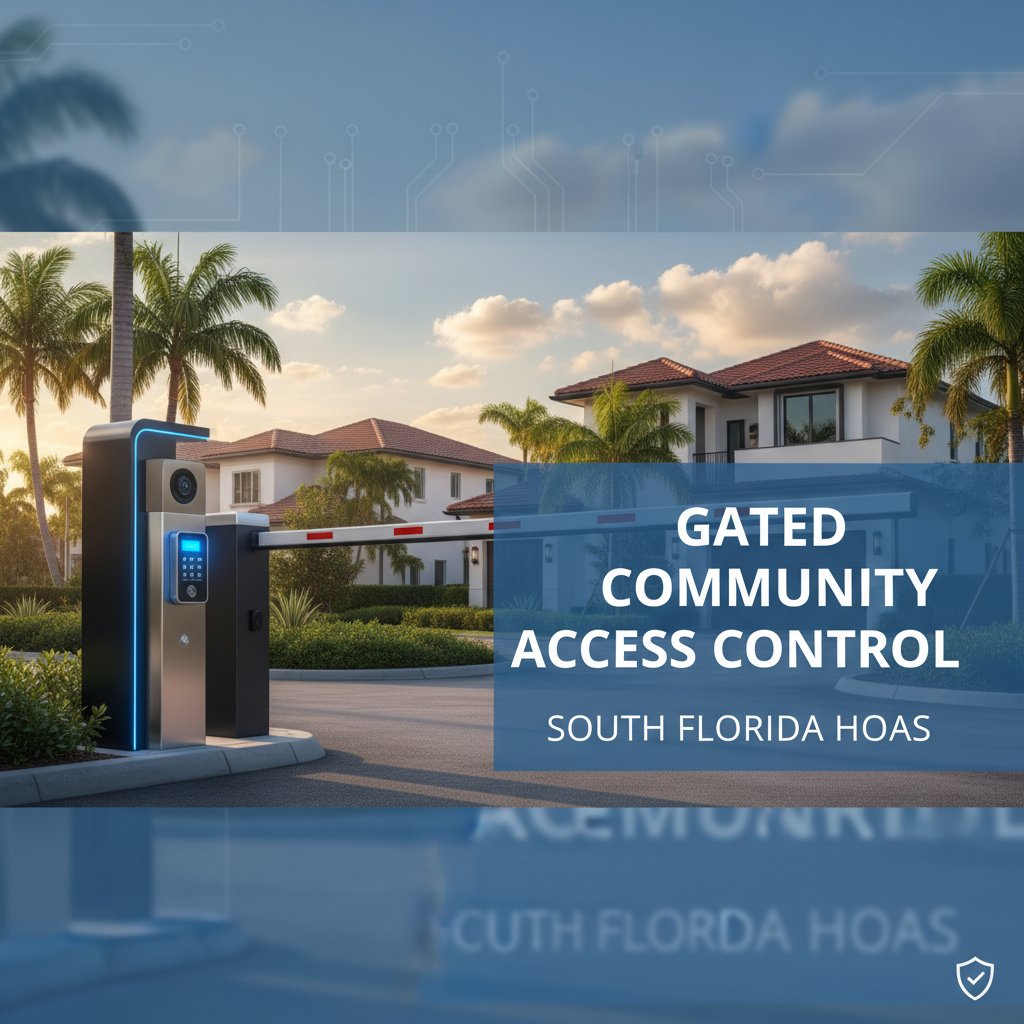
South Florida’s gated communities face unique security challenges in 2026. Between managing hundreds of residents, coordinating guest access, and protecting property values in increasingly sophisticated threat environments, HOA boards need access control solutions that go far beyond basic keypads and clickers. Modern residential access control systems have evolved into comprehensive security ecosystems that integrate visitor management, surveillance, and mobile credentials—all while withstanding the region’s demanding coastal climate.
For HOAs managing properties with 200+ units across Palm Beach, Broward, and Miami-Dade counties, the question isn’t whether to upgrade outdated access control—it’s how to implement systems that balance security, convenience, and long-term value.
Why Traditional Gate Access Falls Short for Modern Communities
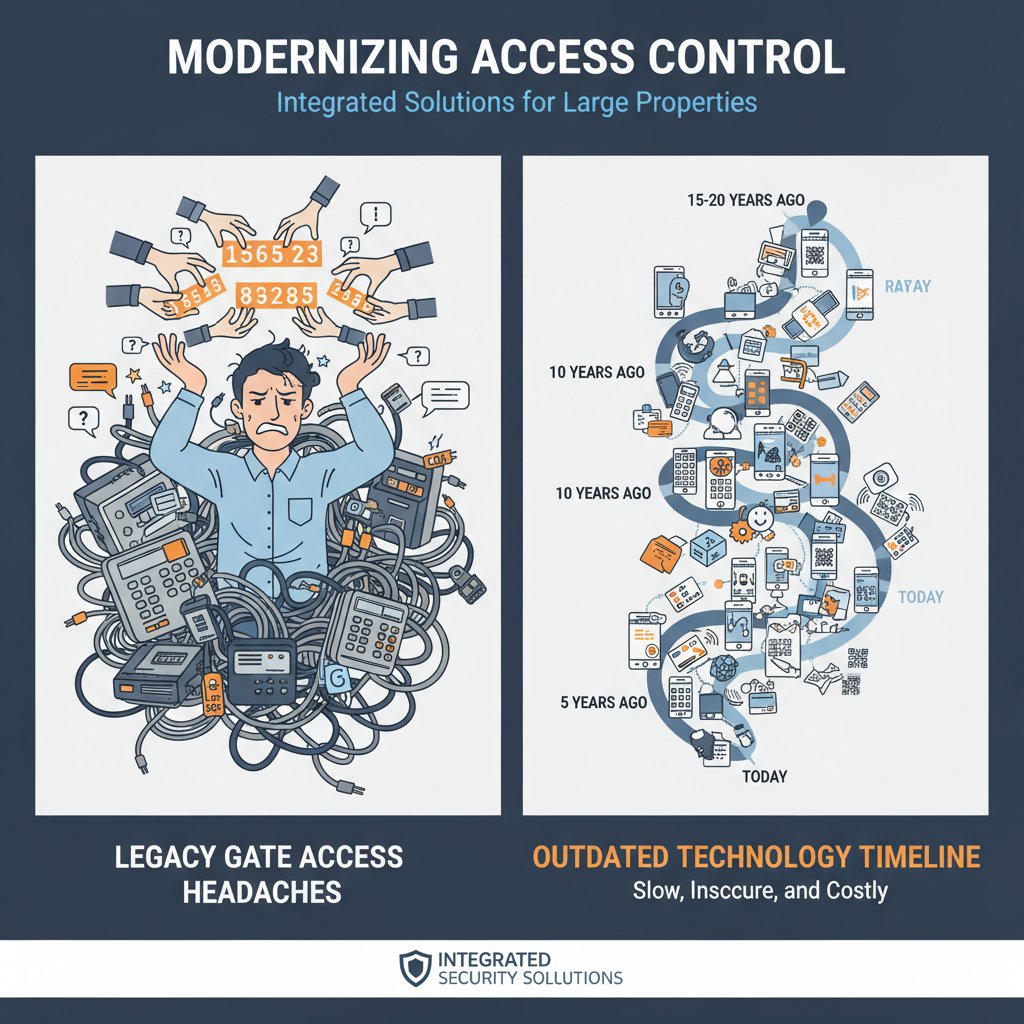
Many established South Florida communities still rely on access control systems installed 15-20 years ago. These legacy systems create operational headaches that compound over time:
- Uncontrolled credential sharing: Residents give access codes to contractors, guests, and service providers who share them further, creating security vulnerabilities
- No visitor accountability: Without integrated visitor management, communities can’t track who entered, when, or which resident authorized access
- Maintenance nightmares: Proprietary systems from defunct manufacturers leave HOAs scrambling for parts or facing complete replacement
- Zero integration: Access control operates independently from cameras, making incident investigation time-consuming and incomplete
- Limited reporting: Board members can’t access data about entry patterns, security incidents, or system usage
The cost of maintaining inadequate systems extends beyond frustration. Property values suffer when prospective buyers compare outdated security to neighboring communities offering smartphone access and integrated surveillance. Insurance carriers increasingly factor security infrastructure into premium calculations. Most critically, liability exposure grows when HOAs can’t demonstrate reasonable security measures.
Integrated Access Control: The Foundation of Community Security
Modern smart access control systems for residential communities function as the central nervous system of comprehensive security ecosystems. Rather than standalone gate operators, today’s solutions connect access control with surveillance cameras, visitor management platforms, and mobile applications—creating security layers that work together seamlessly.
Cloud-Based Platforms Transform HOA Management
Cloud-based access control has fundamentally changed how HOAs manage security. Platforms like Brivo and Verkada eliminate on-site servers requiring IT maintenance, instead delivering management through secure web portals accessible from any device. For HOA board members and property managers, this means real-time visibility into every access point across the community—vehicle gates, amenity centers, pool areas, clubhouses, and package rooms.
The practical advantages for South Florida communities are substantial. When hurricanes threaten and management teams evacuate, they maintain complete system control remotely. Access permissions adjust instantly without gate attendant coordination. System health monitoring provides advance warning of equipment issues before they cause access failures during peak traffic hours.
Brivo’s mobile credentials represent a significant advancement for resident experience. Instead of physical cards that get lost or clickers that fail, residents use smartphones they already carry. Guest access becomes simple: residents issue temporary mobile credentials with specific time restrictions. When the house cleaner’s access expires Friday afternoon, the system automatically revokes credentials without management intervention.
Multi-Tenant Access Control for Complex Communities
Large multi-family residential properties require sophisticated multi-tenant access control capabilities. Each resident needs individualized permissions—some access the fitness center, others don’t; certain owners rent their units requiring temporary tenant credentials; board members need administrative access to specific areas.
Systems designed for multi-tenant environments handle these complexities through granular permission structures. A resident receives credentials for the main gate, their building entrance, assigned parking level, pool area, and clubhouse. Their teenage daughter gets separate credentials without pool access after certain hours. Rental tenants receive credentials that automatically expire at lease end.
This granularity extends to contractors and service providers. Instead of universal access codes shared among dozens of landscapers, plumbers, and vendors, each receives individual credentials tracked to specific authorization. When incidents occur, management immediately identifies who accessed which areas and when.
Surveillance Integration: When Cameras and Access Control Communicate
The power of modern access control systems multiplies when integrated with professional surveillance infrastructure. Standalone cameras record continuously but provide limited investigative value. Integrated systems create event-driven recordings that capture exactly what matters.
Here’s how integration works in practice: When someone uses credentials at the north gate at 2:30 AM, the access control system automatically triggers associated cameras to bookmark that moment, capturing vehicle details and occupants. If that same credential attempts access at the pool area fifteen minutes later—unusual for middle-of-night entry—the system flags the anomaly and records additional footage.
Axis Communications and Hanwha Vision cameras integrate seamlessly with leading access control platforms, providing the high-resolution image quality needed for license plate capture and facial recognition in challenging lighting conditions. South Florida’s intense sunlight and complete darkness in non-illuminated areas demand cameras with wide dynamic range and superior low-light performance—capabilities these professional-grade systems deliver.
For HOA boards investigating incidents, integrated systems reduce investigation time from hours to minutes. Rather than scrubbing through days of footage, managers search by credential use, receiving immediate video clips of specific access events. This proves invaluable for resolving disputes, investigating vandalism, and providing evidence to law enforcement.
Visitor Management: Beyond the Clipboard
Traditional visitor management in gated communities relies on gate attendants with clipboards or outdated software logging guest names. Modern visitor management platforms integrate directly with access control systems, creating seamless guest experiences while maintaining security protocols.
Residents expecting visitors pre-authorize them through mobile apps or web portals. When guests arrive at the gate, they provide names and destination addresses. The system verifies pre-authorization, photographs the vehicle and driver, and issues temporary access credentials—often through QR codes or license plate recognition. If guests arrive without pre-authorization, the system contacts residents for approval before granting access.
This integration eliminates the security gaps inherent in traditional methods. Guest credentials automatically expire after specified time periods. The system maintains permanent records of all visitor activity. Delivery drivers receive one-time access codes specific to individual packages, preventing unauthorized return visits.
For communities without 24/7 gate attendants, integrated visitor management enables unmanned operation without sacrificing security. Video intercoms allow residents to visually verify guests remotely and grant access from anywhere. Verkada’s access control includes integrated intercom functionality, consolidating multiple systems into single platforms that simplify management and reduce equipment costs.
South Florida Considerations: Climate and Infrastructure
Coastal South Florida presents environmental challenges that destroy inadequately specified equipment. Salt air corrodes connections and enclosures. Intense UV radiation degrades plastics and displays. Humidity promotes condensation inside electronic components. Hurricane-force winds test mounting integrity. Summer heat pushes equipment beyond standard operating temperatures.
Professional south florida security installation requires equipment rated for these conditions. Outdoor cameras need IK10 vandal-resistant housings and IP66 or higher weatherproof ratings. Card readers require conformal coating on circuit boards to prevent corrosion. Network infrastructure demands commercial-grade surge protection—lightning strikes remain common throughout summer months, sending destructive power surges through inadequately protected systems.
Installation methodology matters as much as equipment selection. Licensed electrical contractors understand proper conduit sealing preventing moisture intrusion, appropriate wire gauges for Florida’s heat, and ground fault protection requirements. Fortress Global Technology’s licensed contractor status ensures installations meet Florida building codes and manufacturer specifications required for warranty coverage.
Network Infrastructure: The Invisible Critical Component
Access control systems and IP cameras depend entirely on network infrastructure quality. A community might invest in premium Verkada cameras and Brivo access control, but inadequate network design creates system failures, dropped connections, and footage gaps.
Large residential communities require properly designed network architecture with sufficient bandwidth, appropriate switch configurations, and redundant pathways. A 300-unit development with 50+ cameras, multiple access points, and integrated intercom systems generates substantial network traffic requiring managed switches with Power over Ethernet Plus (PoE+) capabilities, virtual LAN segmentation separating security from resident networks, and fiber optic backbone infrastructure connecting distributed buildings.
Fortress Global Technology’s partnership with Velocity MSC addresses this critical layer. Rather than treating network infrastructure as an afterthought, comprehensive installations begin with network assessment and design ensuring adequate capacity for current requirements and future expansion. This systems-thinking approach prevents the common scenario where communities install excellent security hardware that underperforms due to network limitations.
Scalability and Future-Proofing Your Investment
HOA boards making access control decisions in 2026 must consider not just current needs but expansion capabilities. Communities add amenities, parking areas, and sometimes entire building phases. Access control systems should accommodate growth without requiring complete replacement.
Cloud-based platforms excel at scalability. Adding new access points requires deploying additional readers and connecting them to existing infrastructure—the cloud platform automatically incorporates new devices without server upgrades or software licensing constraints. A community starting with vehicle gates and clubhouse access easily expands to include parking garage elevators, tennis courts, and dock access as budgets allow.
Open platform architecture provides another future-proofing advantage. Systems built on open standards like ONVIF for cameras and OSDP for access control avoid vendor lock-in. If a community needs specialized cameras for specific applications years after initial installation, open platforms integrate third-party devices rather than forcing proprietary equipment purchases.
Milestone Systems’ XProtect video management software exemplifies this flexibility, supporting 10,000+ camera models from virtually any manufacturer. Communities can select best-in-class cameras for different applications—thermal cameras for perimeter detection, PTZ cameras for parking areas, fixed cameras for entrances—managing everything through unified software platforms.
The Role of Professional Integration
The complexity of modern residential access control systems demands professional integration expertise. These aren’t consumer products requiring basic installation—they’re enterprise-grade platforms requiring network configuration, system programming, integration between multiple technologies, and ongoing optimization.
Professional integrators like Fortress Global Technology bring capabilities beyond equipment installation. Licensed contractors handle permit applications and code compliance. Integration specialists configure communication between access control, cameras, and visitor management. Project managers coordinate installations minimizing disruption to residents. Ongoing support teams provide maintenance and rapid response when issues arise.
This comprehensive approach prevents the failures common with lowest-bid installations. Equipment arrives on-site, but installers lack network expertise to properly configure switches. Systems get partially programmed, leaving features unused. Integration between platforms never functions correctly. When problems emerge months later, the installing company has moved on to other projects or lacks technical knowledge for troubleshooting.
Fortress GT’s 20+ years of experience since 2004 serving large-scale properties ensures installations meet both immediate operational requirements and long-term reliability expectations. Local teams throughout Southeast Florida and expanding presence in markets like New York provide the ongoing support relationship that transforms security systems from periodic headaches into reliable infrastructure.
Investment Considerations and ROI
HOA boards evaluating modern access control systems naturally focus on costs. Professional installations for large communities represent significant capital investments, typically requiring special assessments or reserve fund allocation. However, the ROI calculation extends beyond upfront expenses.
Operational savings accumulate quickly. Eliminating physical key and fob management reduces administrative overhead. Automated visitor management decreases gate attendant requirements. Integration reduces time spent investigating incidents. Mobile credentials eliminate replacement costs for lost or damaged cards.
Property value protection provides less tangible but equally important returns. Security infrastructure increasingly influences purchase decisions, particularly among younger buyers expecting smartphone access and modern technology. Communities with outdated security compete at disadvantages against properties offering contemporary amenities.
Liability reduction represents another crucial consideration. When security incidents occur, HOAs demonstrating reasonable security measures—modern access control with proper visitor management, integrated surveillance, and maintained systems—face reduced exposure compared to communities with neglected infrastructure.
Taking the Next Step
Upgrading access control systems for established gated communities requires careful planning balancing security improvements, resident convenience, budget constraints, and minimal disruption during implementation. Starting with comprehensive security assessments helps HOA boards understand current vulnerabilities, prioritize improvements, and develop phased implementation plans matching budget realities.
Fortress Global Technology specializes in designing integrated security ecosystems for large residential communities throughout South Florida. Our team evaluates existing infrastructure, recommends technology solutions tailored to specific community requirements, and manages complete installations from permitting through final configuration and resident training.
Whether your community needs complete system replacement or strategic upgrades integrating with existing infrastructure, our experience with properties from 200 to 500+ units ensures solutions scaled appropriately for your needs. Contact Fortress Global Technology today to schedule a comprehensive security consultation and discover how modern access control systems transform community security, convenience, and property values.