
The surveillance camera industry has reached an inflection point in 2026. While 4K cameras now represent nearly 60% of commercial installations nationwide, thousands of businesses continue operating perfectly effective 1080p systems. For property managers overseeing hotels, office complexes, or multi-family residential communities, the resolution question isn’t academic—it directly impacts security effectiveness, infrastructure costs, and storage requirements for years to come.
Understanding which resolution serves your specific security needs requires looking beyond marketing specifications to examine real-world scenarios: Can you identify a license plate from 80 feet? Will your network infrastructure handle the bandwidth? Does your 500-unit apartment complex actually need facial recognition at every entry point?
Resolution Fundamentals: What the Numbers Actually Mean
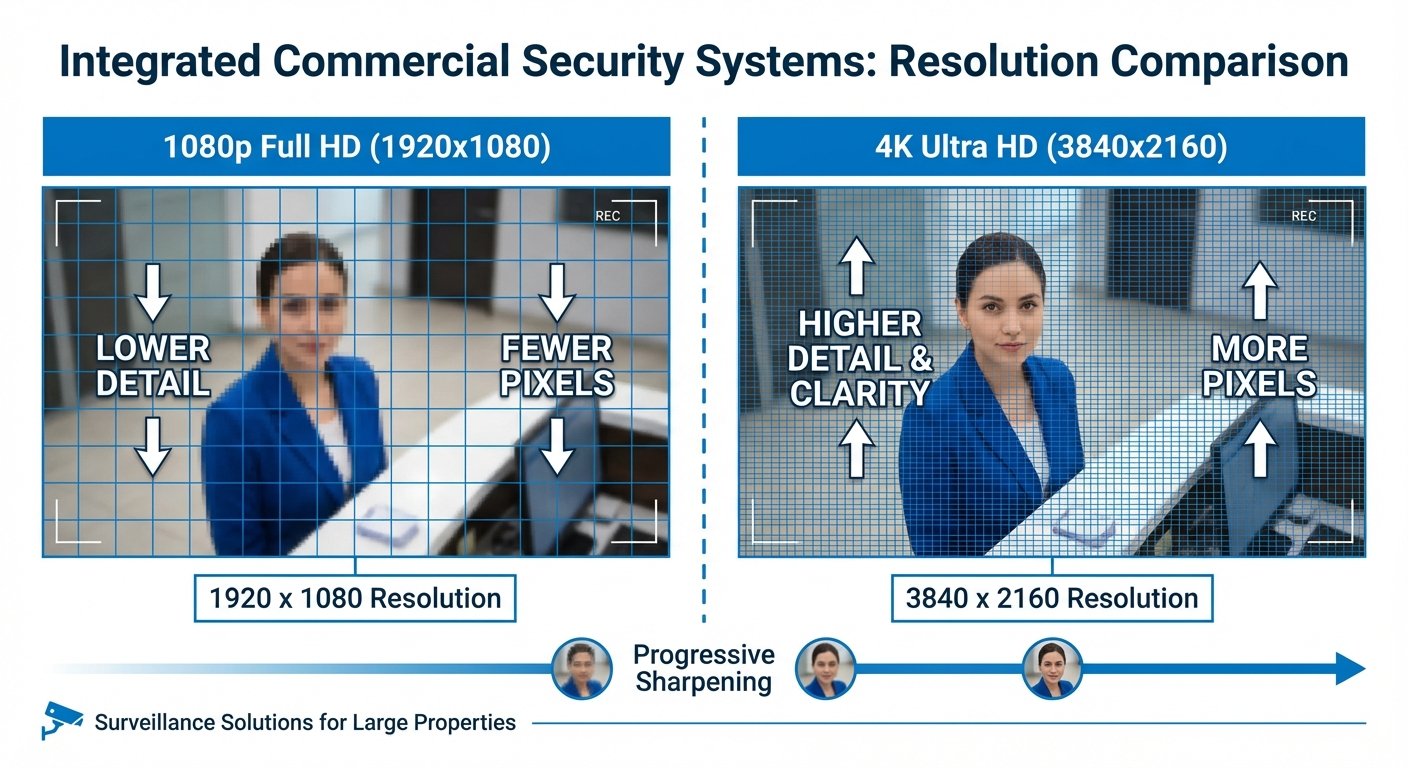
A 1080p camera captures approximately 2.1 megapixels—1920 horizontal pixels by 1080 vertical pixels. This creates sufficient detail for identifying individuals at close to moderate distances and monitoring general activity across typical commercial environments.
4K cameras, technically Ultra HD at 3840×2160 resolution, deliver approximately 8.3 megapixels—four times the pixel count of 1080p. This quadrupled detail allows digital zooming into specific areas without significant quality degradation, a capability that fundamentally changes how security teams investigate incidents.
The critical distinction isn’t just “better picture quality.” Higher resolution extends the functional distance at which cameras can identify faces, read signage, capture license plates, and document fine details that prove essential during investigations or liability disputes.
When 4K Security Cameras Make Operational Sense
Large Coverage Areas Requiring Digital Zoom
Parking structures serving 500+ vehicles present the clearest use case for 4K technology. A single 4K camera with a wide-angle lens can monitor an entire parking level, then digitally zoom to read license plates or identify individuals involved in vehicle incidents without pixelation that renders evidence unusable.
For properties like hotels or mixed-use developments with expansive lobbies, pool decks, or plaza areas, 4K cameras reduce the total camera count needed while maintaining investigative capability throughout the coverage zone. This often offsets the higher per-camera cost through reduced installation labor and infrastructure requirements.
High-Security Zones Requiring Facial Identification
Executive floors in commercial office buildings, hotel back-of-house areas with cash handling, or restricted sections of warehouses benefit from 4K resolution’s ability to capture facial features at distances exceeding 40 feet. When integrated with modern access control systems from providers like Verkada or Brivo, high-resolution cameras create detailed audit trails connecting specific individuals to access events.
Manhattan high-rise residential buildings implementing this approach can identify delivery personnel, visitors, and residents throughout common areas, enhancing both security and tenant services without creating privacy concerns through appropriately positioned cameras.
Perimeter Security and License Plate Recognition
Properties requiring vehicle identification at entry gates, parking revenue control points, or perimeter monitoring achieve significantly better results with 4K cameras equipped for license plate recognition (LPR). The additional resolution captures plate details in varied lighting conditions, at sharper angles, and from greater distances than 1080p systems can reliably manage.
Loading dock security at distribution centers particularly benefits from this capability, documenting every vehicle entering restricted areas with time-stamped, high-resolution evidence that integrates with access control scheduling systems.
Future-Proofing Large Investments
When designing commercial video surveillance for new construction or complete retrofits of properties like 300-room hotels or 400-unit apartment towers, 4K cameras provide longevity that justifies their premium. Technology adoption curves suggest 1080p will face the same obsolescence that affected analog systems—adequate today, but increasingly difficult to integrate with emerging AI analytics, cloud platforms, and automated threat detection.
Brands like Axis Communications and Hanwha Vision now build advanced analytics directly into 4K cameras—people counting, object left behind detection, perimeter intrusion alerts—that perform poorly or not at all with lower resolution feeds. Properties investing in comprehensive security ecosystems benefit from resolution that supports both current needs and capabilities emerging over the next decade.
When 1080p Security Cameras Remain the Practical Choice
Controlled Interior Environments with Proximity Monitoring
Interior hallways in multi-family residential communities, elevator cabs, stairwells, and amenity rooms operate effectively with 1080p cameras. These environments feature controlled lighting, limited distances between cameras and subjects, and security objectives focused on general activity monitoring rather than granular detail capture.
For a 200-unit apartment complex installing 40-60 cameras throughout common areas, selecting professional 1080p cameras from manufacturers like Axis or Hanwha delivers excellent security outcomes while reducing storage infrastructure costs by approximately 60-70% compared to equivalent 4K deployment.
Budget-Conscious Installations with Adequate Coverage
Retail centers, office buildings, and commercial properties with defined budgets often achieve better security outcomes by deploying more 1080p cameras with complete coverage than fewer 4K cameras with coverage gaps. Security effectiveness depends more on camera placement, lighting conditions, and elimination of blind spots than on resolution alone.
A commercial office building might install 1080p cameras at every entrance, exit, stairwell, and corridor intersection, creating comprehensive monitoring that discourages theft and documents all movement patterns. The same budget allocated to 4K would necessitate reducing camera count, potentially creating the vulnerabilities the system should eliminate.
Network and Storage Infrastructure Limitations
Older commercial properties or those with limited network infrastructure face significant challenges supporting 4K surveillance systems. Each 4K camera consumes approximately 8-12 Mbps of bandwidth continuously, compared to 2-4 Mbps for 1080p cameras using modern compression standards like H.265.
For a hotel deploying 80 cameras, this difference represents 320-640 Mbps for 1080p versus 1,280 Mbps for 4K—potentially requiring complete network infrastructure upgrades that dwarf camera system costs. Properties without existing Cat6 cabling, adequate network switching capacity, or substantial storage infrastructure may find 1080p more practical until broader technology refreshes occur.
Cloud-based systems from Verkada partially mitigate this through hybrid architecture with onboard storage, but even cloud systems face bandwidth limitations during live viewing and remote access from multiple users.
Integration with Existing Systems
Properties operating functional video management systems (VMS) like Milestone XProtect with existing camera investments often extend those systems with matching-resolution cameras rather than mixing resolutions that complicate management interfaces and operator training. A parking facility with 30 functioning 1080p cameras might add 10 more 1080p units cost-effectively rather than introducing 4K cameras that require separate handling.
The Infrastructure Reality: What 4K Actually Requires
Network Bandwidth and Switching Requirements
Successful 4K commercial security camera installation demands more than just cameras. Each device requires dedicated network capacity, proper Power over Ethernet (PoE++) switching capable of delivering 25-30 watts per camera, and backbone infrastructure supporting aggregate bandwidth that can exceed multiple gigabits for large installations.
This is precisely where professional installation from licensed electrical contractors becomes essential. Fortress Global Technology approaches every ip security cameras commercial project by first assessing existing network infrastructure, identifying bottlenecks, and designing comprehensive solutions that include necessary switching, cabling, and power infrastructure before cameras even ship.
Storage Calculations That Actually Work
Storage requirements vary dramatically based on resolution, frame rate, compression standards, and retention policies. A 4K camera recording at 30 fps with H.265 compression generates approximately 8-10 GB daily. For a 60-camera hotel installation with 30-day retention, this demands roughly 18-22 TB of storage.
Equivalent 1080p deployment requires approximately 5-6 TB—a difference that impacts both initial investment and ongoing storage maintenance. Cloud-based systems shift these costs to monthly subscription models, while on-premise systems require upfront investment in network video recorders (NVRs) or server infrastructure.
Properties must also consider redundant storage for business continuity, backup systems, and RAID configurations that protect against drive failures. These aren’t optional considerations for business cctv installation—they’re fundamental requirements for security systems protecting significant property investments and potential liability exposure.
Making the Resolution Decision: A Framework for Commercial Properties
Ask These Questions First
What is your primary security objective? General activity monitoring suggests 1080p adequacy. Detailed forensic investigation capability requires 4K investment.
What distances are involved? Cameras monitoring subjects within 20-30 feet perform well at 1080p. Coverage areas exceeding 40-50 feet benefit significantly from 4K resolution.
Does your network infrastructure support the bandwidth? Honestly assess existing capacity before committing to resolution that exceeds infrastructure capabilities.
What is your realistic budget for the complete system? Include cameras, installation, infrastructure upgrades, storage, and ongoing maintenance—not just camera purchase prices.
How long do you plan to operate this system? Installations expected to serve 7-10+ years justify 4K investment for future-proofing. Systems with 3-5 year horizons may reasonably deploy 1080p.
The Hybrid Approach: Strategic Resolution Deployment
Sophisticated commercial properties increasingly deploy mixed-resolution systems that match camera capabilities to specific security requirements. A luxury apartment complex might install 4K cameras at vehicle entry gates and main lobbies where identification matters most, while using 1080p throughout interior hallways, stairwells, and amenity areas where proximity monitoring suffices.
This approach optimizes budget allocation, reduces infrastructure burden, and delivers enhanced security exactly where it provides maximum value. Video management systems from Milestone or Hanwha Vision’s WAVE platform handle mixed-resolution environments seamlessly, presenting operators with unified interfaces regardless of underlying camera specifications.
Integration Considerations: Cameras as Part of Complete Security Ecosystems
Resolution decisions cannot exist in isolation from broader security architecture. Modern commercial video surveillance works most effectively when integrated with access control systems, visitor management platforms, and alarm systems that create comprehensive security ecosystems rather than disconnected point solutions.
When someone uses a credential to enter a restricted area, access control systems from Brivo or Napco Continental can trigger associated cameras to begin recording, tag video with the credential holder’s identity, and create searchable audit trails that combine access events with video evidence. This integration provides security value that exceeds what cameras or access control achieve independently.
Properties investing in 4K cameras should ensure their broader security platform—including access control, video management systems, and any AI analytics tools—can fully leverage the additional data those cameras provide. Otherwise, the resolution investment delivers minimal incremental value beyond what 1080p would accomplish.
Why Professional Installation Matters for Commercial Surveillance
Camera resolution specifications tell only part of the story. Improperly positioned 4K cameras deliver worse results than professionally installed 1080p systems. Factors like lens selection, camera angles, lighting conditions, network configuration, and integration with other security systems determine whether surveillance investments actually protect your property.
Licensed electrical contractors with specific expertise in commercial security camera installation handle the complete scope: permit acquisition, low-voltage cabling installation, network infrastructure configuration, camera positioning based on security objectives, integration with access control and alarm systems, and ongoing support throughout the system’s operational life.
For properties throughout Palm Beach County, Broward County, and Miami-Dade County, this includes addressing Florida-specific challenges like hurricane resistance, humidity exposure, and extreme heat that affects outdoor camera longevity. Manhattan properties face different considerations—retrofit installation in occupied buildings, coordination with union labor, and integration with existing building management systems.
Looking Forward: Resolution Trends Through 2026 and Beyond
The security camera market continues evolving rapidly. While 4K dominates new commercial installations in 2026, emerging technologies like 12-megapixel multi-sensor cameras and specialized AI-powered analytics shift the conversation beyond simple resolution metrics toward comprehensive situational awareness.
Properties planning security investments today should focus less on resolution specifications alone and more on complete system architecture: How will cameras integrate with access control? What analytics capabilities do you need? How will the system scale as your property expands? What ongoing support ensures the system remains functional and current?
These questions matter more than megapixel counts because they determine whether your surveillance investment actually protects your property, reduces liability exposure, and provides operational benefits beyond just recorded video.
Partner with Security Integration Experts
Fortress Global Technology has designed and installed comprehensive security ecosystems for hotels, multi-family residential communities, commercial office buildings, and parking facilities throughout Florida and nationwide since 2004. As an authorized integrator for Verkada, Axis Communications, Hanwha Vision, Brivo, and other leading manufacturers, we provide objective guidance matching specific security requirements with appropriate technology solutions.
Whether your property needs 4K cameras throughout, strategic 1080p deployment, or a hybrid approach that optimizes your security investment, our licensed teams handle complete installation from infrastructure assessment through final configuration and ongoing support. We don’t just sell cameras—we design integrated security solutions that protect your property investment for years to come.
Contact Fortress Global Technology today to schedule a comprehensive security assessment for your commercial property. Let’s discuss what resolution and system architecture actually makes sense for your specific security objectives, infrastructure realities, and budget parameters.